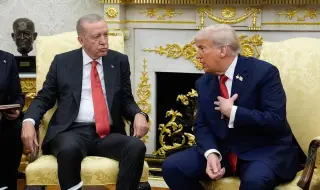
At the end of September, a remarkable scene unfolded in the White House: US President Donald Trump appeared extremely talkative and enthusiastic when he praised his Turkish counterpart Recep Tayyip Erdogan to journalists: “We have a good relationship. He does a very good job in his country. He is a highly respected person. Everyone respects him. I respect him too“. But after the praise, something was also heard that represents a huge economic and geopolitical challenge for Ankara: Trump asked Erdogan to stop buying oil and gas from Russia.
This pressure was also intensified by the G7 countries. After a virtual meeting on Wednesday, the seven leading Western industrial countries - Germany, Britain, Canada, France, Italy, Japan and the United States - jointly announced that it is time to “increase pressure on Russian oil exports“. The goal is to reduce the revenues with which Moscow finances its war against Ukraine.
So far, Turkey has not reacted to Trump's statements and the demands of the G-7. This is not surprising, since energy dependence is the most vulnerable point of Bulgaria's southern neighbor - Turkey is extremely dependent on Russia for energy supplies.
Facts about Turkey's energy dependence
According to data from the Turkish Energy Markets Regulatory Authority (EPDK), last year 66% of Turkey's imports of oil and oil products were from Russia. A year earlier, according to leading energy expert Nejdet Pamir, this share was over 68%, and at the end of 2022 it was 41%.
The increased imports are a direct consequence of Russia's aggression against Ukraine: Turkey is taking advantage of the fact that Russia is under pressure due to EU sanctions and is offering its oil at prices that are at times up to 15% lower than international market prices. Stopping imports would not only threaten Turkey's security of supply, but would also take away one of its important (price) advantages. In 2024, natural gas supplies from Russia accounted for 41% of all imports of this raw material. Russian gas is supplied to Turkey mainly via the Blue Stream and TurkStream gas pipelines. along the bottom of the Black Sea.
According to a report by the Turkish Chamber of Mechanical Engineers, the share of fossil fuels in the country's energy market in 2022 was about 84%, while that of renewable energy sources - only 16%.
What is Ankara's strategy?
Immediately after Trump's meeting with Erdogan, the Kremlin spoke out on the issue. Spokesman Dmitry Peskov stressed that the gas pipelines to Turkey continue to operate at “full capacity“. There will be no interruption as long as these supplies are “useful“ for Turkey. Peskov emphasized Moscow's position: “Turkey is a sovereign state that makes its own decisions regarding cooperation with us.“
Observers do not expect Turkey to stop importing energy from Russia in the coming years. Instead, Ankara is betting on a strategy of quiet diversification.
During Erdogan's last visit to the United States, state-owned company BOTAŞ signed two long-term contracts to expand its natural gas sources: an agreement with the American company Mercuria, which will deliver a total of 70 billion cubic meters of liquefied natural gas (LNG) from 2026 over a period of 20 years; In addition, a preliminary agreement with Woodside Energy for 5.8 billion cubic meters of LNG was announced.
Diversification efforts
Kadri Tastan, a Turkey expert at the American foundation German Marshall Fund, noted that in recent years the Turkish government has indeed made great efforts to diversify its sources in order to ensure its energy security. At the same time, it also promotes local energy sources, especially renewable energies.
According to him, the new agreements with the US, in addition to diversification, also have a strategic aspect. Tastan recalls that political relations with the US have been tense in recent years. President Trump's priority is to make America a leading energy country and increase sales of fossil fuels such as liquefied natural gas. Such energy deals could become a facilitating factor for negotiations on other political issues with the US, the observer continues. Trump is waging a tariff war, and here LNG purchases could be used as a bargaining chip under the slogan: “Look, we buy more LNG than you, so you could concede to us on other issues“. In addition to the US, in recent years Turkey has signed LNG contracts with Egypt, Algeria, Qatar and Nigeria.
Ankara is also dependent on Moscow in the field of nuclear energy
Turkey is also heavily dependent on Russia for other energy sources. In 2022, the country covered 43% of its brown coal needs with Russian imports. In addition, the first nuclear power plant in Akkuyu in southern Turkey is being built by the Russian state company Rosatom.
Its completion has been constantly delayed due to sanctions against Russia. According to Turkish Energy Minister Alparslan Bayraktar, it should be operational next year. However, the plant will probably not be fully ready until 2028.
Thus, Turkey will have to perform complex acrobatic tricks with its energy supplies in the future: torn between the West, which is demanding sanctions against Moscow, and Russia, which remains its most important energy supplier for the time being.
Author: Elmaz Topcu