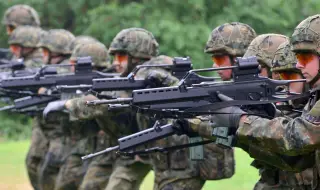
In Germany, security threats are increasingly being discussed openly, primarily from Russia. On Monday, the heads of the Federal Intelligence Service (foreign intelligence), the Federal Office for the Protection of the Constitution (domestic intelligence) and the Military Counterintelligence (MAD) answered questions from deputies from the Special Services Oversight Committee for three hours in the Bundestag.
What are Russia's goals in Europe?
Understandably, politicians have shown the greatest interest in Russia. In his analysis, Martin Jaeger, president of the BND and until recently German ambassador to Ukraine, noted that in general in the modern world "the line between war and peace is becoming increasingly blurred" and that Russia, waging war against Ukraine, has not yet officially declared it - in the sense of international law.
This feature is also important for Germany, the head of foreign intelligence believes. “Russia is hiding its intentions, but in fact wants to check what our limits are (of what is permissible - ed.). In Europe, at best, there is an icy peace, which in places can at any moment develop into a hot confrontation. We must prepare for further aggravation of the situation.“
According to Jaeger, Moscow's goals are to undermine NATO, destabilize democracy in Europe and split society. In his opinion, Moscow is counting on “the real chance to expand its sphere of influence in the West and make Europe, which is much stronger in economic terms, dependent on Russia“. “To achieve this goal, if necessary, Russia will not hesitate to enter into a direct military confrontation with NATO“, assures Jaeger. Moscow's methods are not new, what is new is that sabotage, espionage, disinformation and contract killings are becoming more frequent.
Foreign intelligence will take "higher risks"
The new president of the Federal Intelligence Service indirectly criticized those who think that Germany has time to prepare. “We cannot afford to relax, proceeding from the fact that a possible attack by Russia cannot be expected earlier than 2029. "The fire has already been opened," said Jaeger, referring to the date repeatedly mentioned by Federal Defense Minister Boris Pistorius.
According to him, Germany's foreign intelligence service is responding to the challenge, including by strengthening its operational direction. Jaeger said that under his leadership the service would "take more risks," but did not give details. "We will have to confront our adversaries where necessary," Jaeger stressed. In this regard, he expects the powers of his agency to be expanded, and a corresponding bill has already been submitted to the Bundestag.
Russia is trying to recruit military personnel
The head of the Military Counterintelligence Service, Martina Rosenberg, is also hoping for a new law - an agency for which there has been no law until now.
The expansion of powers is also necessary for carrying out surveillance outside Germany, for example in Lithuania, where the Bundeswehr is creating a tank brigade. To protect the German servicemen stationed there from attempts to be recruited, primarily from neighboring Russia, a representative office of the Military Counterintelligence will be opened in Lithuania. According to Rosenberg, attempts to recruit German servicemen who have family ties in Russia have become more frequent.
Information campaign against "one-time agents"
Countering the recruitment of civilians is the task of the Federal Office for the Protection of the Constitution, which has recently been headed by Sinan Selen. He told the Bundestag about Russia's attempts to recruit so-called "one-time agents" for sabotage, for example in transport - ordinary citizens who are not connected with the special services. According to Selen, this recruitment is carried out among the "discontented" on social networks, for example, opponents of Germany's military support for Ukraine.
In this regard, Selen's department has recently launched an information campaign. The head of the service believes that "at an early stage" success is possible, i.e. people can give up further contacts with the Russian special services.
In front of the deputies, the three heads of the special services in Germany were unanimous that the situation with threats to Germany's security could worsen, including due to the development of new technologies, primarily drones and artificial intelligence.
Author: Roman Goncharenko