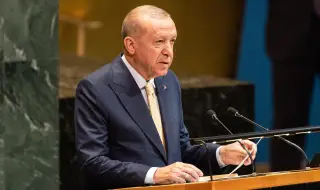
Turkish President Recep Tayyip Erdogan commented on the results of the summit in Sharm el-Sheikh and outlined the necessary steps to resolve the Palestinian issue and reconstruct the Gaza Strip. During his return from Egypt, Erdogan told journalists that the decision of Western countries to recognize a Palestinian state could serve as the basis for a two-state solution, the Turkish president's press office reported, quoted by BTA.
He warned that without recognition of an independent Palestinian state, the process would remain “half-done”. Erdogan said that during the visit he had held meetings with French President Emmanuel Macron and British Prime Minister Keir Strummer, and noted that the Palestinian issue was at the center of the international political agenda for the first time in a long time.
According to the Turkish president, the meeting in Egypt was a turning point: he welcomed the ceasefire between Israel and “Hamas“ and pointed out that the exchange of hostages and prisoners was of key importance. At the same time, Erdogan stressed that the agreement reached was primarily about a ceasefire and did not finally resolve the Palestinian issue. For Turkey, the decision means recognizing Palestine with its 1967 borders and with East Jerusalem as its capital, he categorically stated.
Erdogan insisted that the agreement be strictly implemented “point by point“ and stressed the need for US influence on Israel to continue throughout the process. He added that he had received assurances from the US side and expected President Donald Trump's support to continue. Erdogan described the signatures on the document - his, Trump's, Egyptian President Abdel Fattah al-Sisi's and the Emir of Qatar's - as "a testament to the will for peace in history".
Regarding humanitarian aid, the Turkish president announced that 350 Turkish trucks had already entered Gaza, while the agreement calls for 600 trucks per day. He described Gaza as "a pile of rubble" and insisted on immediately starting the implementation of the agreed Recovery Plan, developed jointly with Arab and Islamic countries. Erdogan pointed out that there are projects developed by the Organization of Islamic Cooperation and the Arab League and that serious financial support is needed for their rapid implementation.
Turkey is already providing practical assistance: Erdogan said that the country will help provide shelter before winter, will send vans and other means, and the wounded are being treated in hospitals in Ankara and Istanbul. He assured that Turkey will continue its activities together with partners from the Persian Gulf, the United States and European countries, specifying that bilateral talks are forthcoming between Foreign Minister Hakan Fidan, Defense Minister Yasar Guler and other representatives.
Erdogan also noted that discussions are continuing on the structure and composition of the international forces to be deployed in Gaza, and warned that calming the situation should not lead to complacency - Israel already has a “bad history” regarding the observance of ceasefires, the president said, and warned that any return to mass attacks would have grave consequences.
According to Erdogan, the work of the international community is only just beginning: the conflict, in his words, has left great damage and the resistance of “Hamas“ has not been broken. He stated in a cliché that “Gaza gave 70 thousand victims, but did not surrender“, and assured that Turkey will continue to work to ensure that the genocide is not forgotten and that the perpetrators are held accountable.
Erdogan emphasized the role of diplomacy, including “telephone diplomacy“ with Trump, and expressed hope that all countries that signed the agreement will act as guarantors of its implementation and the creation of a sustainable atmosphere of peace.