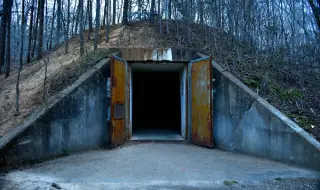
The parking lot near Geneva looks like a completely ordinary place at first glance. But a massive sliding door leads to a huge bunker. Behind it, an entire underground world is revealed, offering shelter for over 2,000 people. This bunker has kitchen facilities, a water tank, a power generator, beds, chemical toilets, emergency exits, ventilation shafts.
In addition, in the event of a nuclear, chemical or biological disaster, there is also a decontamination room - an airlock, in which potentially infected people stay for nearly 12 minutes and are covered with a special decontamination powder until the air is completely renewed, reports the German public media ARD.
Is all this too much? Not at all, believes Swiss bunker inspector Christian Sinigalia. "We are a small country and we don't have enough people to protect ourselves," he explained to ARD. That's why we rely on bunkers - with a coverage rate of over 100 percent, Switzerland is prepared for emergencies like almost no other country in the world. The nine million inhabitants can count on more than 370,000 bunkers.
It all started during the Cold War
The idea for bunkers came about during the Cold War. After neutral Switzerland was spared from the First and Second World Wars, the arms race between the great powers raised fears of a new conflict, including nuclear conflict. "It then became clear that the population had to be protected - both from air attacks and from weapons of mass destruction. "And not only in public buildings, but also in private homes," Daniel Jordi from the Federal Office for Civil Protection in Bern told ARD.
Since 1963, it has been a law that every new residential building must have a shelter. As an alternative, it must be possible to rely on a similar public space, for the construction and maintenance of which a certain amount must be paid.
Regular inspections are mandatory
These private and public shelters must be inspected regularly to ensure that they are in constant readiness - at least once every ten years. The costs of maintaining private bunkers are borne by the homeowners, ARD explains, describing a bunker in an apartment building in Geneva. It is currently used as a storage room - there are skis, bottles of wine, Christmas decorations, children's shoes. At first glance, it doesn't look like a shelter, but that's not a problem, explains inspector Christian Sinigaglia - the residents usually have enough time to clean the shelter if necessary. The only thing he doesn't like is the cobwebs at the entrance: "In Switzerland, we really want everything to be clean and tidy," he explains and makes a note on his list.
Too few bunkers in Germany
Meanwhile, since the start of the war in Ukraine, Germany also wants to increase the number of its bunkers, which currently number less than 600 and are in urgent need of renovation. The existing bunkers offer shelter for only half a million people. And among Christian Sinigaglia's clients are Russian oligarchs living in Switzerland. They are particularly keen to have their bunkers in full readiness, the inspector tells ARD.
Author: Stefanie Dott (ARD)