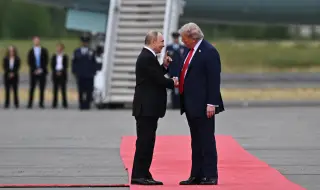
What is happening now is a model of what we have seen since Donald Trump returned to the White House at the end of January 2025. This is how Claudia Mayor, a security expert from the German Marshall Foundation, commented on the upcoming meeting between Trump and Putin in Budapest to the German public media ZDF.
"Military pressure is working"
According to Marshall, the American president is only increasing pressure on Moscow rhetorically. At the same time, Putin continues to use delaying tactics. "There was some hope that Trump could put more serious pressure on Russia, as he did with the parties in the Palestinian-Israeli conflict. But recent months have not given any signs that the US is ready for this," the expert pointed out.
At the same time, according to her, Putin's call to Washington (it became known that he initiated the phone call) is a sign that "military pressure is working." Major believes that the statements by the US authorities about plans to provide Ukraine with Tomahawk cruise missiles probably made the Kremlin chief express a desire to talk to Trump personally so that he would not allow such deliveries.
Russia expert Gerhard Mangot, a professor at the University of Innsbruck, said in an interview with the Austrian television channel PULS 24 that he was somewhat surprised by the information about the upcoming meeting between Putin and Trump. In recent weeks, everything seemed to be "as if the US was positioning itself as a supporter of Ukraine", with talk of supplying "Tomahawk" missiles and other types of weapons to Kiev, Mangot recalled. But he clarified that Trump apparently had no intention of supplying missiles to the Ukrainians, but rather talked about it to put pressure on Russia and make it change its position.
"Trump is playing his typical game of threats and dialogue"
Swiss expert on military economics Markus Koepp notes that Trump's typical game of threats and dialogue is currently underway. Speaking to ZDF, Koep explains the US president's changing course on the war in Ukraine as Trump's attempt to apply the approach he used in the Middle East conflict to this case.
Koep suggests that Trump is thinking: "This combination of pressure and diplomacy worked in the Gaza Strip. So I'll do the same with Russia." That's why he spoke to Putin on the phone, but at the same time invited Ukrainian President Volodymyr Zelensky to Washington.
Markus Koep warns that "this indefinite movement on both tracks" may continue, but it will not end the war. Trump will have to clearly define his position if he really wants to end the war. Because this can only be achieved "from a position of strength in relation to Russia".
Will there be a repeat of Alaska in Budapest?
In connection with the upcoming meeting between Putin and Trump in Budapest, Claudia Mayor predicts that "the negotiation process will ultimately change nothing". She believes that Putin regularly manages to convince Trump to refrain from really active steps.
This was also the case during and after the August meeting between the two in Alaska, which became "a success for Putin that increased his prestige". Mayor recalls that this meeting did not lead to an end to the war or to the launch of serious negotiations on the issue.
In this regard, Mayor worries that "Alaska will be repeated in Budapest" and Putin will again manage to mislead Trump. "The US may continue to take an unclear position - either as a mediator or closer to Russia", the expert points out.
Possible risks of the new meeting between Trump and Putin
According to Professor Gerhard Mangot, we are currently witnessing "another sharp change in the position of Donald Trump, who, it seems, has almost said goodbye to attempts to resolve the conflict". According to Mangot, "Trump is euphoric after the signing of the Gaza peace agreement and wants to try to achieve success once again".
The risk that the future meeting hides lies in the fact that Putin's position does not change. "Russia continues to insist on its two main demands, which are that Ukraine, at least de facto, must cede part of its territory and abandon its bid to join NATO, becoming a neutral country. Trump must tell Putin that these demands are unacceptable to Kiev. The big question is what will happen then. Will the negotiations fail?", Mangot asks. He adds that their failure would be a harbinger of an increased military escalation of the conflict.
"This is a slap in the face to the European Union"
The choice of Budapest as the venue for the new meeting is "a bad sign for Kiev and a slap in the face for the EU", says Professor Mangot. After all, the EU advocates "comprehensive arms supplies to Ukraine so that it can win the war or secure a stronger position in the negotiations".
And at this very moment, "Trump appears with the idea of a new meeting with Putin", and in the capital of a country that has "the most positive attitude towards the Russian president and his war among EU members". While in Brussels they expected that "Trump would significantly increase military support for Ukraine, something completely different happened".
According to the professor, this will be a summit of two great countries, because Trump hardly "consulted with the leaders of the EU member states" about holding a new meeting with Putin on the eve of the phone call with Putin. "Everything is like in the bad old days, the great countries are trying (themselves – ed.) to settle the issues", concludes Gerhard Mangot.
Author: Mikhail Metelkin