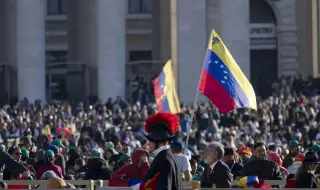
Pope Leo XIV will finally canonize the beloved "doctor of the poor" today Venezuela has canonized Jose Gregorio Hernandez, giving the Caribbean country its first saint and a reason to celebrate amid a years-long economic crisis and renewed tensions with the United States, the Associated Press reported. Hernandez, revered by millions for his dedication to the poor, will be canonized alongside Mother Carmen Rendiles Martinez, founder of a Venezuelan religious order, during a mass in St. Peter's Square. Thousands of Venezuelans are expected to attend, while thousands more who cannot travel to Rome will watch the event in Caracas, where the Vatican service will be broadcast live this morning in the city's downtown square. The service will also produce Papua New Guinea's first saint: Peter To Roth, a layman who was killed in prison in 1945 for advocated for monogamous marriage in an era when polygamy was practiced. Seven people in total will be canonized in a ceremony that the previous Pope Francis initiated as one of his last acts as pope.
In fact, Pope Francis approved Hernandez's canonization from his hospital room on February 24, agreeing to skip the typical Vatican process of confirming a miracle and declaring him a saint based on the "widespread veneration for the "holy doctor" "among the faithful," the Vatican said.
Hernandez is beloved by Venezuelans, with his face depicted in graffiti in Caracas, in portraits in hospitals and in photographs adorning home altars.
As a doctor in Caracas in the late 19th and early 20th centuries, he refused to take money from poor people for his services and often gave them money for medicine, earning him the nickname "the doctor of the poor." He was assassinated in 1919 while crossing the street shortly after picking up medicine from a pharmacy to take to a poor elderly woman.
After his death, Hernandez became a religious icon, and when Pope John Paul II visited Venezuela in February 1996, he received a petition signed by 5 million people - almost one in four Venezuelans - with a request to declare Hernandez a saint.
"For Venezuelans, this is truly a national event of the highest importance," said Silvia Correale, who is leading the initiative for his canonization. "Certainly, the canonization of José Gregorio is desired by the entire Venezuelan people and is expected by all people," she added.
Arquimides Blanco, 60, said he is not a big fan of Hernandez, but he recognizes the importance of his canonization for Venezuela at this time. Blanco is a member of a cultural collective tasked with painting the streets around the church of the iconic La Pastora parish as part of preparations for the canonization.
"Maybe I'm not a big fan of José Gregorio, but I understand that he is Venezuelan and that his canonization in the context of the entire geopolitical situation is important," he said.
The canonization is a long-awaited event and a new impetus for Venezuela, just weeks after opposition leader María Corina Machado won the Nobel Peace Prize. It comes at a time of rising tensions with the United States over Washington's use of military force against suspected drug cartels.
Last week, US President Donald Trump said he had authorized the CIA to conduct covert operations in Venezuela, and added that he was considering ground operations in the South American country.
Venezuela's economy has been in crisis for a decade, prompting the emigration of millions of Venezuelans, first to other South American countries and in recent years to the United States.
The country's economic crisis has been exacerbated by US sanctions. The government of President Nicolas Maduro, who was re-elected last year despite credible evidence that he lost the election, has been forced to cut subsidies, making it very difficult to meet the daily needs of the 80 percent of the country's population, who are believed to live in poverty, according to the AP.