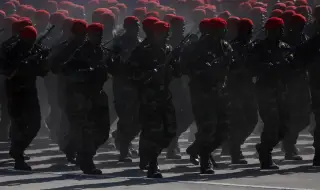
"The New York Times" was the first to report on October 15 a classified document that said the Donald Trump administration's strategy for Venezuela is to remove President Nicolas Maduro from power. The administration in August announced a $50 million reward for information leading to the arrest and conviction of Maduro on drug trafficking charges, BTA reports.
The long and often sinister history of American intervention in Latin America appears to be entering a new phase, writes the Spanish newspaper "Pais". After a 20th century filled with active intervention, sometimes overt, such as the 1989 invasion of Panama, and other times – supposedly secret, such as the support for the Chilean coup against Salvador Allende in 1973, the Donald Trump administration has approved covert CIA operations in Venezuela.
Adding the five attacks on suspected drug ships and a small submarine in the Caribbean Sea, as well as the strange withdrawal of the head of the US Southern Command, responsible for military operations in the region, two years earlier than planned, the pressure on Venezuelan President Nicolás Maduro becomes even more direct.
Many dictatorships in Latin America were built thanks to US support both for the autocrats themselves and for the power apparatus that supported them: the memory of the sinister School of the Americas, which trained more than 45,000 Latin American officers and instructed them in dirty war tactics, has not yet been erased, although it closed its doors in 1984, notes "Pais".
The CIA was a direct executor of coup plots, assassination plots and the rise of the Contra rebel movement in Sandinista Nicaragua in the 1980s, adds the Spanish publication. Its explicit mention by Trump, who recently admitted to having approved CIA operations, is not only unprecedented, but above all a warning.
In the 20th century, Washington's proactive policy in the region served to preserve strategic interests (the Panama Canal), economic interests (the United Fruit Company's monopoly in Guatemala) and political interests that could be summarized in the fight against communism, especially during the Cold War, points out "Pais". In recent decades, these goals have overlapped with the powerful war of the Drug Enforcement Administration (DEA) against drug trafficking, the newspaper recalls.
This is precisely the argument that Trump has used to put pressure on Venezuela and try to force Nicolás Maduro to step down, subjecting the Chavista leadership to a regime of psychological terror. The six operations carried out in Caribbean waters since September 2 have resulted in the deaths of at least 27 people and two survivors, a Colombian citizen and an Ecuadorian citizen, who were detained and will be repatriated. Trump announced a second phase of the offensive, which implies the start of ground raids.
Unrest in the Caribbean
This strategy has contributed to stoking unrest in much of the region. The military campaign in the Caribbean is being watched closely and with alarm by the embassies in Washington of Latin American countries that are home to organizations involved in drug trafficking, such as Mexico and Colombia. They are also watching with the hope that Trump’s interventionist ambitions will not extend beyond Venezuela. In Mexico alone, there are six criminal cartels that the US State Department added in February to its list of “foreign terrorist organizations”: the Sinaloa, Jalisco New Generation, Northeast and Michoacan New Family cartels, as well as the Gulf Cartel and the United Cartels.
"There is fear of who could be next", explains a Latin American diplomatic source in the US capital. "And there is also some confidence that countries that maintain good relations (with Washington) will be spared. Although with this administration, you never know."
In both Colombia and Mexico, Trump has already used the war on drugs and his zero-tolerance immigration policy to justify imposing tariffs. However, apart from clashes with Colombian President Gustavo Petro, most recently over the latter's support for Gaza at the UN General Assembly, Venezuela is seen in Bogota and Mexico City as Washington's chosen target for the time being.
The "Monroe Doctrine"
In any case, the concerns have a historical basis. The idea of the "Monroe" Doctrine, named after President James Monroe (1758-1831) - "America for the Americans" - fostered a kind of unity of destiny on the continent: Latin American countries, despite themselves, became the backyard of the United States. As the only superpower in the Western Hemisphere, the White House felt authorized to intervene politically and militarily, although in recent decades the deployment of the army and the CIA has in some cases been overshadowed by agents of the Drug Enforcement Agency (DEA), notes "Pais".
Thanks to the "Monroe" Doctrine and its addition by US President Theodore Roosevelt (1858 - 1919), which explicitly authorized the use of military force, Washington assumed the authority to take all necessary measures to "stabilize" a country or, under the action of the IMF and the World Bank, to bail it out when it fails to meet its financial obligations.
The good old days... of the Cold War
During the Cold War, the US successfully participated in about 50 coups d'état within the framework of the so-called doctrine of containing communism, points out "Pais". In other cases, they unsuccessfully encouraged actions such as the failed Bay of Pigs invasion of Cuba or the numerous assassination attempts on Fidel Castro.
Since the early 20th century, the United States has also intervened in one way or another in Honduras, Cuba, Nicaragua, Panama, and Guatemala, as well as in Colombia and Mexico. Its sinister intervention expanded to the countries of the Southern Cone (Argentina, Chile, Paraguay, and Uruguay) in the 1960s and 1970s.
The most striking example of this was Guatemala in 1954, against President Jacobo Arbenz's sweeping agrarian reform, which threatened the interests of the U.S.-based United Fruit Company, which owned 40% of the country's land. The American intervention was known as Operation PBSuccess and was a full-fledged coup, described by Mario Vargas Llosa in one of his last novels, "Hard Times".
Between 1964 and 1965, the United States also encouraged a coup that overthrew the government of the social democrat Juan Bosch in the Dominican Republic and occupied the country for 17 months. On the island of Grenada in 1983, the United States ended the first and only Marxist government in the English-speaking Caribbean.
The most egregious example of U.S. interventionism in Latin America was Operation Condor: a coordinated campaign of repression between South American dictatorships and Washington in the 1970s and 1980s, aimed at eliminating the left through a systematic plan of torture, assassination, and "death flights" (victims are thrown from planes or helicopters and their bodies fall into oceans, large rivers or mountains – ed. note) in Argentina, Bolivia, Chile, Paraguay, Uruguay, Brazil, Ecuador and Peru, recalls "Pais".
In 1973, Chilean General Augusto Pinochet organized a coup against the legitimate government of socialist President Salvador Allende, a project strongly influenced by then US Secretary of State Henry Kissinger, who received the Nobel Peace Prize that year. The United States also contributed to the establishment of a military dictatorship in Brazil with its support for the 1964 coup against the leftist João Goulart. The military remained in power until the 1980s.
The Panama Incident, one of the last American invasions and perhaps the first to be broadcast almost live, toppled Manuel Antonio Noriega, a former CIA informant turned tyrant. Washington used the leader's ties to drug trafficking as a pretext to remove him from power. In December 1989, 24,000 troops were sent to Panama to capture him, and after several weeks of fighting, the general finally surrendered on January 3, 1990.
The Venezuelan Exception
Curiously, Venezuela is not included in the map of American interventions on the continent in the 20th century. Venezuela's economic interests, aligned with those of the superpower, ensured smooth relations until Hugo Chávez came to power. The closest thing to direct American intervention in this country is implied by the confessions of John Bolton, former national security adviser during Trump's first term, who was recently indicted for his work with classified information. In 2022, Bolton admitted that he had helped organize coup attempts in other countries, but without success due to the "incompetence" of the administration he served in. Bolton mentioned, among other things, without giving details, the crisis with Venezuela in 2019 in connection with Washington's recognition of Juan Guaidó as interim president. And although Maduro has always condemned US interference in Venezuela's internal affairs, the consequences of the hostile actions have never reached this far, notes "Pais".
After US President Donald Trump gave the CIA carte blanche to conduct covert operations in Venezuela, it caused outrage from the leader of the South American country, the BBC reported.
In recent weeks, the US has carried out at least five strikes on suspected drug-trafficking boats in the Caribbean, killing 27 people. US Air Force B-52 bombers also circled the Caribbean Sea for several hours last week, the BBC recalls.
BBC Verify confirmed that three B-52 bombers - similar to those used during the conflicts in Iraq and Syria - took off from Barksdale Air Force Base in Louisiana. A spokesman for the Air Force's Global Strike Command also confirmed to CBS that the three aircraft had been flying missions near Venezuela.
Nicolas Maduro, whose legitimacy as Venezuela's president is internationally disputed, has called for peace with the United States. In a televised address, he addressed the "people of the United States," saying "no to war, yes to peace."
The increased U.S. military presence in the region has raised concerns in Caracas of a possible attack. There are reportedly about 10,000 US troops stationed in the Caribbean, either on ships or in Puerto Rico, as well as a submarine.
UN-appointed human rights experts have described US strikes on targets Washington identifies as drug traffickers as "extrajudicial executions".
Meanwhile, the commander of US Southern Command (SOUTHCOM), Navy Admiral Alvin Halsey, announced on social media that he will retire by the end of the year. His authority includes the Caribbean Sea, where the US has carried out strikes against suspected drug ships on Trump's orders.
The arguments for Trump's decision
According to the "New York Times" Trump's authorization of the CIA would allow the agency to conduct operations in Venezuela unilaterally or as part of a broader U.S. military effort. Speaking to reporters in the Oval Office alongside FBI Director Kash Patel and Attorney General Pam Bondi, Trump was asked about the New York Times report.
"Why did you authorize the CIA to go into Venezuela?", a reporter asked. "I actually authorized it for two reasons," Trump said in a highly unusual admission from a U.S. commander in chief about an intelligence organization whose activities are usually shrouded in secrecy.
"First of all, they (Venezuela) emptied their prisons in the United States of America." He added: "And the other thing is drugs. We have a lot of drugs coming from Venezuela, and a lot of Venezuelan drugs are coming by sea, so you can see that, but we will also stop them by land." Venezuela plays a relatively small role in the drug trade in the region, the BBC pointed out. The US president would not comment on whether the CIA's goal would be to overthrow Maduro.
Mick Mulroy, a former CIA paramilitary officer and assistant deputy secretary of defense, told the BBC: "In order for the CIA to conduct covert operations, you need a presidential order specifically authorizing that, with specific actions specified."
Mulroy added that such a thing would mark a "significant increase" of efforts against drug trafficking organizations.
"Maybe a real "Sicario", he said, referring to the 2015 American thriller by director Denis Villeneuve, in which an FBI agent accompanies two Rangers on undercover operations against drug cartels in Mexico.