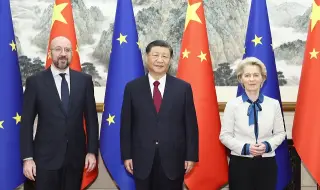
The European Union is considering all options to reduce its dependence on Chinese rare earth elements and battery materials, European Commission President Ursula von der Leyen said at the "Global Dialogue" conference in Berlin, quoted by Reuters, BTA writes.
"In recent weeks and months, China has dramatically tightened controls on the export of rare earth elements and battery materials, which poses a significant risk," Von der Leyen said. She said that in the short term, Brussels is focused on finding solutions through dialogue with Chinese partners, but stressed that the EU is preparing a new plan to limit its dependence on Chinese raw materials of strategic importance.
According to her, the initiative, called RESourceEU, will be similar to the REPowerEU scheme, introduced after the start of the war in Ukraine to reduce dependence on Russian energy supplies. The new plan will cover joint purchasing, storage and increased investment in strategic projects for the extraction and processing of critical raw materials within the European Union.
Von der Leyen specified that the EU will seek to accelerate partnerships for the extraction of critical raw materials with countries such as Australia, Canada, Chile, Greenland, Kazakhstan, Uzbekistan and Ukraine. The plan also includes stepping up efforts to recycle critical materials in products sold in Europe.
"The aim is to ensure access to alternative sources of critical raw materials in the short, medium and long term for our European industries," she said.
On October 9, China imposed new restrictions on the export of rare earth elements and battery materials – a measure that Western analysts say is a response to tariffs imposed by the United States.
Von der Leyen warned that these restrictions are also having a strong impact on the European economy, especially on strategic sectors such as automotive, defense, aerospace, artificial intelligence chip production and data centers.
"If you consider that over 90 percent of our consumption of rare earth magnets comes from China, you see the risks for Europe and its key industries," she said, adding: "In the short term, we are focused on finding solutions with our Chinese partners, but we are ready to use all the tools at our disposal to react if necessary."
Von der Leyen's comments came days after French President Emmanuel Macron told European Union leaders to consider using the EU's so-called "anti-coercion" instrument (ACI), the bloc's most powerful trade tool - against China if they fail to find a solution to Beijing's planned controls on the export of important raw materials, Bloomberg also recalls.
This tool has never been used. It is designed primarily as a deterrent, and if necessary, as a response to deliberate coercive actions by third countries that use trade measures as a means of exerting pressure on the political choices of the EU or its members. The ACI was also discussed in the bloc over the summer, before the EU managed to negotiate its customs deal with the United States.