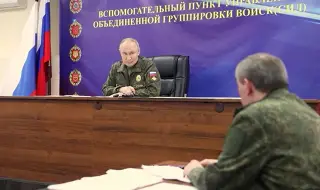
President Vladimir Putin said today that Russia has tested its nuclear-powered cruise missile "Burevestnik", Reuters reported, quoted by BTA.
Here are some key facts about the weapon.
- The 9M730 "Burevestnik" is a low-flying, ground-launched cruise missile that can not only carry a nuclear warhead, but also has a nuclear propulsion system. NATO calls it the SSC-X-9 Skyfall.
- Putin, who first unveiled the project in March 2018, said it has unlimited range and can evade US missile defense systems. But some Western experts have questioned its strategic value, arguing that it would not add capabilities that Moscow does not already have and could emit radiation along its flight path.
- Putin said today that the weapon is unique. Top Russian General Valery Gerasimov, chief of the Russian Armed Forces’ General Staff, told Putin that the missile system had traveled 14,000 km (8,700 miles) and spent about 15 hours in the air in a test on October 21. He said it is nuclear-powered, can overcome any missile defense system and has an unlimited range.
- Its nuclear propulsion is designed to allow it to fly much farther and longer than missiles with traditional turbojet or turbofan engines, which are limited by the amount of fuel they can carry. This would allow it to "hang around" for a longer period of time before hitting its target. The Nuclear Threat Initiative, a US-based non-profit security organization, said the missile could potentially remain airborne for days: "In service, the Burevestnik would carry a nuclear warhead, orbit the globe at low altitude, evade missile defenses and follow terrain; and deliver the warhead(s) to a difficult-to-predict location (or locations)," a 2019 report said.
- Some Western experts have argued that the Burevestnik's subsonic speed would make the missile noticeable and that the longer it stays airborne, the more vulnerable it becomes. In response, Russian military expert Alexei Leonkov wrote in 2019 that the Burevestnik's role would be to eliminate "remnants" of from the enemy's command posts, military bases, factories and power plants, after Russia has already launched intercontinental ballistic missiles, by which time the enemy's air defense systems will not be able to stop them. He stated that "Burevestnik" will "return the aggressor countries to the Stone Age", by completing the destruction of their military and civilian infrastructure.
- The International Institute for Strategic Studies, citing a specialized Russian military magazine from 2021, stated that "Burevestnik" It will have a theoretical range of up to 20,000 km, so it could be based anywhere in Russia and hit targets in the US.
- The same Russian magazine pointed out that the missile's theoretical flight altitude is only 50 to 100 meters, which is much lower than that of a conventional cruise missile, which would make it difficult to detect by air defense radars.
- A 2020 report by the US Air Force's National Aerospace Intelligence Center indicates that if Russia manages to put the "Burevestnik" into service, it would give Moscow a "unique weapon with an intercontinental range".
- Experts estimate that it will be launched by a small solid-fuel rocket that will propel air into an engine containing a miniature nuclear reactor. Superheated and possibly radioactive air will be expelled, providing forward thrust.
- The "Burevestnik" has a poor test record with numerous failures in the past, according to Western experts. In 2019, at least five Russian nuclear specialists died in an explosion and radiation leak during an experiment in the White Sea, and US intelligence sources said they suspected it was part of a test of the "Burevestnik". Putin presented the widows of the dead with the highest state awards, saying that the weapon they were developing had no analogues in the world, although he did not name it. Putin announced a successful test of the missile in October 2023.
- Two American researchers said in 2024 that they had identified the likely location of the missile, next to a nuclear warhead storage facility called "Vologda-20" or "Chebsara".
The site is located 475 km north of Moscow.