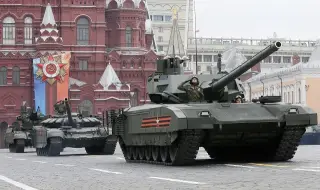
In its war in Ukraine, Russia has depleted most of its old tanks that can be restored and is planning a major upgrade of its armored forces over the next ten years. This is according to new open source intelligence (OSINT) analyses published by independent researchers and cited by the BBC.
According to satellite image analyst Jonpy99, there are 2,538 old tanks left in Russian storage bases, of which only 92 are in good condition, while the rest need repair or are no longer repairable. Another investigation, conducted by the Ukrainian analytical group Frontelligence Insight, indicates that Moscow has prepared an ambitious program for rearming tank troops.
Journalists from the OSINT community have published internal documents of "Uralvagonzavod" - the main Russian tank manufacturer. According to them, the main emphasis is on the production and modernization of T-90 models, including the new version T-90M2 "Rivok-1". The peak of production is planned for the period 2027-2029, after which a model change or modernization of production lines is planned. The general plan envisages the production of 2,611 tanks between 2026 and 2036 - a number that would be sufficient to fully restore the Russian armored fleet and prepare for a new large-scale conflict.
According to data from open sources, as of 2021, immediately before the invasion of Ukraine, Russia had about 2,609 tanks in its operational units. About half of them were relatively new or modernized vehicles such as the T-72B3M, T-80BVM and T-90M "Probyv". In parallel, 12 new tank battalions with about 400 more vehicles were formed. After the start of the war, the Russian army was expanded by the creation of two new military districts - Moscow and Leningrad, and formations from the "people's republics" were included in it. in Donetsk and Lugansk, as well as private military companies such as "Wagner".
At the beginning of the full-scale invasion, Western experts estimated that Russia had between 3,000 and 4,000 active battle tanks. If reserves are included, their number exceeds 10,000 units, according to the Military Balance report of the International Institute for Strategic Studies (IISS) in London. According to the analytical group Oryx, since the beginning of the war, Russia has lost over 4,000 tanks - destroyed, abandoned or captured by Ukrainian forces. This is a conservative estimate based on photo and video evidence, and the real losses may be higher. In 2024 alone, losses are estimated at about 1,400 vehicles.
In 2025, losses of Russian armored vehicles will significantly decrease. According to the Ukrainian General Staff, 68 tanks were destroyed in September - the lowest monthly figure since the beginning of the war. On the one hand, this is due to the fact that Russia has exhausted its reserves and can no longer lose hundreds of vehicles per month, and on the other - to a change in tactics, in which offensives are led mainly by infantry units, while armored vehicles are used more sparingly.
Russia compensates for its losses by repairing, modernizing and restoring old tanks from the Soviet period. The fastest way to replenish reserves is to evacuate damaged tanks from the battlefield and return them to service after repair. Mobile repair brigades operate in the rear, and according to estimates, between 30 and 50 percent of the hit vehicles can be restored. Another source of equipment are the old Soviet models T-80, T-72, T-62 and even T-55, which are being modernized with new sights, thermal imagers and dynamic protection. Although outdated, they allow the number of combat units to be maintained.
OSINT analyst Jonpy99 estimates that Russian tank storage bases have been almost two-thirds emptied since the start of the war, with the more modern machines being the first to be withdrawn. He believes that with enough funds and time, Russia could restore even severely damaged or obsolete tanks if the Kremlin decides to invest the necessary resources.
The main manufacturers of new tanks in Russia are "Uralvagonzavod" in Nizhny Tagil, which produces the T-90 and T-72 models, and the Omsk Transport Machine-Building Plant, which specializes in the T-80. In 2024, about 240 new or modernized T-90s were produced in Russia, which means about 20 tanks per month. According to internal documents analyzed by Frontelligence Insight, Moscow plans to increase production by 80% and begin mass production of the new T-90M2 "Rivok-1" version. Production is expected to peak at 428 tanks per year by 2028.
For the decade 2026-2036, Russia plans to produce and modernize 1,783 T-90M and T-90M2 tanks, as well as 828 T-72 tanks upgraded to the T-72B3M standard. The total number of modernized equipment amounts to 2,611 vehicles, with the bulk of production to be completed by 2029. According to the analysis, this may be a signal of preparation for a new large-scale military conflict or a transition to a new generation of tanks after 2030.
The documents do not contain information about the Omsk plant, which is responsible for the restoration of the T-80, nor about the promising T-14 "Armata" tank, the serial production of which was promised back in 2015. In 2025, the T-14 did not even appear at the parade on Red Square, which indicates that Russia is currently relying mainly on modernized versions of old models, rather than a completely new generation of combat vehicles.