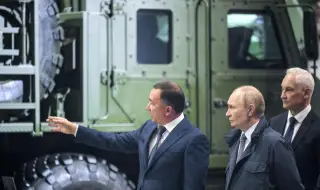
Russian President Vladimir Putin continues to actively present new Russian nuclear weapons as a means of pressure on the United States. Meanwhile, State Duma deputy Alexei Zhuravlev threatened that Russia could deliver nuclear missiles to Venezuela and Cuba, calling the US “an enemy of Russia“, reports News.bg.
This is stated in an analysis by the Institute for the Study of War (ISW).
On October 29, Putin said that a day earlier Russia had tested the nuclear-powered “Poseidon“ unmanned underwater vehicle, emphasizing its alleged speed and power. He also recalled the recent test of the Burevestnik missile, also nuclear-powered and with similar characteristics.
According to ISW, the announcement of these tests contradicts US President Donald Trump's call on October 27 for Putin to focus his efforts on ending the war in Ukraine, rather than developing new weapons.
Putin has been detailing the alleged capabilities of the new systems to enhance the impression of his nuclear threats and to extract concessions from Washington regarding the conflict in Ukraine. In this way, the Kremlin is trying to use the fear of nuclear escalation to force the US and European leaders to accept Russian conditions that Moscow cannot impose on the battlefield.
Although the presented weapons may have new technical characteristics, they do not change the basic balance of nuclear deterrence that has existed since 1945. The United States, along with its French and British NATO allies, continue to maintain powerful nuclear triads, ensuring the stability of the deterrent system.
Russia also continues to use Belarus as a tool to threaten Europe, including by deploying Oreshnik missiles.
According to US intelligence assessments, Vladimir Putin is more determined than ever to achieve military victory in Ukraine - a position that is consistent with recent statements by senior Russian officials.
Putin and Russian lawmakers are increasing the use of imperial and Soviet rhetoric to unite society around the idea of fighting "internal and external enemies". According to ISW, this is likely intended to prepare public opinion for new repressions, increased mobilization and even a possible future confrontation with NATO.