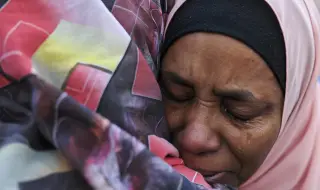
Tens of thousands of people in Al Fashir are exposed to unprecedented atrocities after the city was taken over by the RSF ("Rapid Reaction Force") militias, who have been waging war with the Sudanese army for two and a half years. The UN estimates that about 150,000 people are trapped in Al Fashir, the capital of North Darfur.
Meanwhile, it was reported that the RSF militias have accepted the offer of a humanitarian ceasefire made by a US-led mediation group. At the same time, a Sudanese military official told the Associated Press that the Sudanese army would only agree to a ceasefire if it included a withdrawal from civilian areas and the handing over of weapons.
Executions, atrocities, sexual violence
Earlier, the UN emergency relief coordinator for Sudan, Denise Brown, told the German public broadcaster ARD that she had credible information about sexual violence and executions of unarmed civilians in Al-Fashir. The World Health Organization also has verified information about mass killings of people in the last remaining hospital in Al-Fashir. More than 460 people were killed there, Brown reported.
Sudanese human rights lawyer Mohaned Elnur confirmed to the German media that the most serious human rights violations are taking place in the city. According to him, there are even cases of people being buried alive, and the militias are filming the atrocities on video and then publishing them. The scenes are horrifying, the lawyer added.
One reason for the boundless cruelty is the fact that war criminals in Sudan have not been held accountable for a long time. "Impunity for more than two decades has been the cause of many of the crimes in Sudan." Until accountability is sought, there will be further crimes, the lawyer is convinced. According to him, the same perpetrators committed genocide, war crimes and crimes against humanity in Darfur two decades ago.
Meanwhile, prosecutors at the International Criminal Court in The Hague announced that they were launching an investigation following the latest reports of crimes in Al-Fashir. For Mohaned Elnur, this is a good sign, as the International Criminal Court has finally convicted one of those responsible for the genocide in Darfur more than 20 years ago.
"Some may say that this is justice long overdue, but the people of Darfur were truly happy with the verdict. It gave them the feeling that this could heal their wounds," Elnur explained to ARD.
Which countries are involved?
But what needs to be done to put an end to the brutal war and the suffering of the population? Elnur advocates, above all, international pressure on the participants. Including on the countries that support both warring parties.
For example, the Sudanese army receives support from Egypt and Iran, ARD points out. And the United Arab Emirates is believed to be supplying weapons to the RSF militias. The Emirates deny it, but Mohaned Elnur is adamant: "The US and other countries must prevent the UAE from inciting the war," says the lawyer, adding that Iran, Egypt and Saudi Arabia must also be prevented from supporting the warring parties. This also applies to Turkey, says Elnur. "Otherwise, the war will continue for a long time."
According to the lawyer, crimes are committed not only by RSF, but also by the Sudanese army. According to him, it uses hunger as a weapon of war and bombs villages with civilians.
21 million are threatened with famine
The International Propaganda Initiative (IPC), the main global hunger monitoring organization, has meanwhile confirmed that the population is starving in parts of Sudan. Not only in North Darfur, but also in other regions of the country: more than 375,000 people are affected by the most severe humanitarian catastrophe, and 21 million are threatened with famine.
The world's largest humanitarian catastrophe - this is how the UN describes the situation in Sudan. And there is no end in sight to the suffering.
Author: Heiko Wirz (ARD)