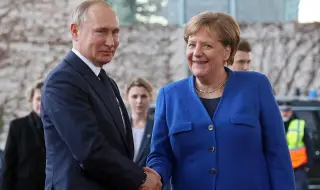
A former German diplomat called the error in assessing Russian President Vladimir Putin's intentions "one of the biggest mistakes of German foreign policy", DPA reported, quoted by BTA.
Sigmar Gabriel, who was economy minister and then foreign minister under Angela Merkel from 2013 to 2018, testified today before a commission investigating possible Russian influence on a German foundation linked to the "Nord Stream" gas pipeline.
Although Gabriel denied that there was close cooperation between the federal government and the foundation in the state of Mecklenburg-Western Pomerania, where the pipeline ends, he admitted that mistakes had been made in working with Russia.
The error in judgment about Putin and his intentions "is one of the biggest mistakes of German foreign policy that I have had to deal with," Gabriel said, adding that it was a "bitter realization of the mistake."
The investigation by the state parliament in Mecklenburg-Western Pomerania is aimed at clarifying whether Russia exerted influence over the management of the foundation, which helped complete the "Nord Stream 2" in 2021 despite US threats to impose sanctions on the companies involved.
The "Nord Stream" pipelines were built to carry Russian natural gas across the Baltic Sea to Western Europe via Germany.
Although work on the first pipeline - "Nord Stream 1" - began in 2011, plans to build "Nord Stream 2" continued even after Russia annexed the Crimean peninsula in 2014 in violation of international law.
Gabriel, who was also leader of the Social Democrats for years, today defended the government's decision to stick to plans for "Nord Stream 2" despite the annexation of Crimea, saying that halting its construction could harm negotiations in the conflict.
He said the main goal had always been to guarantee gas supplies to Germany, which had become "a private sector issue" as a result of the liberalization of the energy market.
"Nord Stream 2" never went into operation due to Russia's invasion of Ukraine, and Russia stopped supplies through "Nord Stream 1" due to Western sanctions imposed in the wake of the war.
Both pipelines were hit by underwater explosions in September 2022, with a group of Ukrainians believed to be behind the sabotage.
Former German Chancellor Olaf Scholz, who led the country's center-left government from 2021 to 2024, is expected to speak to the committee on November 21, and the results of the inspection will be presented next year.