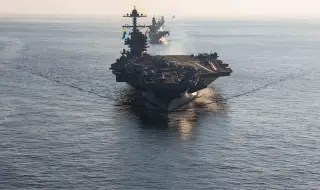
The dispatch of the US aircraft carrier “Gerald Ford“ off the coast of Latin America has further increased the high tension between the US and Venezuela. It is the largest warship in the world: it is 333 meters long, carries up to 90 combat aircraft and helicopters, as well as several thousand soldiers, and is powered by a nuclear reactor, recalls the German public media ARD.
Previously, against the backdrop of the increased US military presence in the region, the Venezuelan government announced that it was strengthening its army: nearly 200,000 servicemen from all branches of the armed forces plus members of paramilitary militias have been called up for exercises.
The context of the conflict
For several weeks, the US military has been attacking vessels in the Caribbean Sea that are suspected of smuggling drugs. In at least 19 such attacks in international waters, at least 76 people have been killed so far. The US claims that the operations are part of the fight against drug trafficking.
US President Donald Trump accuses Venezuela of actively promoting drug smuggling and thus endangering the security of the United States and its citizens.
Venezuelan President and nationalist Nicolas Maduro, however, considers the killings of alleged drug traffickers to be illegal executions and suspects that the US is preparing to overthrow him.
A number of international law experts doubt the legality of the US actions, and more critical voices define them as outright “illegal”, even if they are directed against drug traffickers. So far, Washington has not presented evidence that the target of the US attacks is only the boats of traffickers.
Venezuela – a drug smuggling hub?
Venezuela is more of a transit country for drugs destined for Europe, but not a producer. The drugs reach the United States through other routes. The synthetic opioid fentanyl, which has caused huge problems, is mainly produced in Mexico with raw materials from China and is smuggled into the United States from there. Cocaine is transported from ports in Colombia, Ecuador and Peru across the Pacific Ocean to Central America and Mexico and overland to the United States. Only a small part reaches the United States directly through the Caribbean Sea and the Pacific Ocean or is transported by airplanes.
Some experts say that US authorities are not accurately representing the situation with organized crime in Venezuela. For example, the news site Insight Crime, which specializes in organized crime investigations, writes that the Tren de Aragua gang, which Trump constantly talks about, is not an international drug trafficking network. It is more of a network of various gangs involved in racketeering, kidnapping and street drug trafficking.
The Trump administration has accused Maduro, without providing evidence, of using the Tren de Aragua gang or the Sinaloa cartel to transport drugs to the United States. Washington classifies the criminal groups as “foreign terrorist organizations“ and in August 2025 doubled the bounty on Maduro's head to $50 million.
What role does Venezuela's oil play?
The South American country is believed to have the world's largest oil reserves, surpassing even Saudi Arabia. Trump recently told reporters that Maduro had offered “everything” -including natural resources- to avoid conflict with the United States.
According to the “New York Times“ The Venezuelan government's generous offer also included opening all existing and future oil and gold mining projects to American companies, which would receive preferential treatment. However, the publication claims that Trump rejected the offer of economic benefits, writes ARD.
Is it Maduro's head?
The Trump administration accuses Venezuelan President Nicolas Maduro of being involved in drug smuggling into the United States and wants to put him on trial in the United States. During his first term, Trump tried to overthrow the regime in Caracas, but failed, and Maduro remained in power. It is possible that Trump now wants to make up for this failure. He recently publicly announced that he had approved covert CIA operations in Venezuela. Such measures are always intended to influence political, economic or military relations in a country without revealing the role of the United States, the German publication explains.
James Story, who was the US ambassador to Venezuela during Trump's first term, considers the current US measures "too destructive" to be aimed solely at the fight against drugs. Therefore, according to him, it is possible that this is an "action against the Maduro regime", with which his supporters will be forced to reject their loyalty to the president or even hand him over to the US.
In an interview with CBS News, for example, Trump said that President Maduro's days are numbered.
Will Trump invade?
Trump wants to go down in history as a president of peace and has repeatedly stated that he is trying to end wars, not start new ones. One thing is certain: Trump is known for his impulsive actions, and the transfer of the aircraft carrier "Gerald Ford" fueling speculation that the US could attack targets in Venezuela.
ARD also recalls the following fact: When CBS recently asked Trump whether the US would go to war against Venezuela, he replied evasively: “I doubt it, I don't believe so“, and then added: “But they've treated us very badly – not just in terms of drugs.“