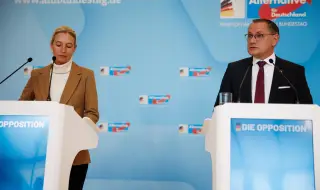
At the end of last week, the co-chairs of the far-right and traditionally considered pro-Russian party "Alternative for Germany" (AfD) showed unity after public disagreements over the AfD's controversial relations with Russia, DPA reported, BTA reported.
“We will continue to work together for a policy that benefits Germany and its citizens”, wrote Alice Weidel and Tino Krupala in a joint letter. “To this end, we maintain good relations with our European and international partners.“
Weidel, who topped the anti-immigrant party's ticket in the February election and was effectively its candidate for chancellor, has distanced herself from Krupala on the subject of Moscow.
In recent weeks, the party's relations with Russia have caused a scandal in Berlin after several AfD deputies announced their intention to attend a conference in the Russian Black Sea resort of Sochi despite the war in Ukraine.
Weidel criticized the visit, saying that he “doesn't understand what they are doing there“.
Then, early last week, Krupala stirred up the party by appearing on a talk show, during which he said he saw no threat to Germany from Russia.
Any country could be a threat to Germany, he said. Then, in response to a clarifying question about whether he thought Luxembourg, Poland or Finland could also threaten the Federal Republic, he said: "Of course, Poland could also be a threat to us," he pointed out, and highlighted Warsaw's reluctance to hand over to Berlin a suspect for involvement in the explosion of the "Severin Stream" gas pipeline.
He then continued his speech with a comment about Russian President Vladimir Putin. "Personally, he has done nothing to me," said Krupala.
His words were condemned by the AfD parliamentary spokesman on defense issues. Rüdiger Lukassen, a former Bundeswehr officer, described the statement as “strange“.
The differences between the co-chairs began to appear publicly in September, when they commented on the topic of Poland shooting down Russian drones that entered its airspace.
While Weidel called on Moscow to reduce tensions, Krupala condemned the public release of what he said were inaccurate and false claims that “drones assembled from polystyrene and plywood can fly 1,400 kilometers to Poland“.
A DELICATE MOMENT
The unusual discord within the AfD ranks came at a time when established politicians in Germany are accusing the party of acting as a Trojan horse for the Kremlin and even spying for Russia, the publication notes. „Euroactive“.
The scandal also erupts at a time when the AfD is on the crest of a wave, often registering in opinion polls support of over 20%, which the party received in the February elections, in which it rose to become the second political force in Germany.
The electoral bastion of the AfD, which has been active on the German political scene for more than a decade, is in the former communist eastern provinces, where many people have a more positive attitude towards Russia despite the high tension between it and NATO over the war in Ukraine.
But, on the other hand, the party wants to create a more refined image so as to expand its positions in West Germany.
The party also wants to maintain closer relations with the team of US President Donald Trump, who has openly supported the far-right party, especially now that the Republican has distanced himself from Putin over Moscow's unwillingness to negotiate peace in Ukraine, notes „Euroactive“.
THE DISSENSATION FROM ABOVE IS AN EXPRESSION OF THE MOMENTS FROM BELOW
„We here in this country should not be warmongers, we should be peacemakers“, said Krupala in his television appearance last Thursday.
The conservative Christian Democratic Union's security spokesman Roderich Kiesewetter called the AfD co-chairman „a Russian troll and a madman at the helm of the AfD“.
The sharp contrast in the party leadership's positions reflects the tension among its core supporters on the issue of Russia, points out „Euroactive“.
Over 44% of AfD supporters are fear that "Russia could launch a military attack on Germany in the near future," according to a recent survey by the INSA Institute, commissioned by the business publication "Handelsblatt." Nearly 52 percent of respondents hold the opposite view.
Since last month, the AfD has been accused of using its right to parliamentary questions to collect confidential details about critical infrastructure and military and security issues, especially in the eastern state of Thuringia.
AfD politicians described the accusations as “malicious“, but did not give any arguments as to why they were interested in these topics, “Euroactiv“ notes.
MAGA OR KREMLIN
According to the director of the INSA institute, Hermann Binkert, if the AfD takes a strongly pro-Kremlin position, this could harm “its domestic political position“ - but also deepen its contradictions with other European nationalist parties that are more inspired by Trump's “Make America Great Again” movement (MAGA) than from Putin's war.
This view is also shared by conservative MP Mark Henrichmann, chairman of the Bundestag's committee on oversight of the services.
Weidel "feared that statements like those by Krupala would damage the party's public image, deprive it of the support of the hard-line wing of the MAGA movement in the United States and thus ruin its chances of electoral success," Henrichmann told AFP.
According to Green security expert Konstantin von Notz, the AfD is acting "completely shamelessly as a mouthpiece for Russia, China and other countries that want to harm" Germany.
He said Weidel only spoke out against her party colleagues' visit to Russia when the issue had become public and had stirred up public opinion. Von Noz added that he still saw no fundamental change in the behavior of Weidel and her party.
“For the AfD, the alternative for Germany is an autocratic Russia“, he told AFP. “The party leadership's half-hearted and clumsy attempts to cover this up hardly inspire confidence in anyone.“
CHANCELLOR AGAIN REJECTS ANY COOPERATION WITH THIS PARTY
Meanwhile, German Chancellor Friedrich Merz said again that his party would not cooperate in any way with the AfD.
“And it's not just because there's a firewall between us and the AfD - there's a whole universe of differences between us and this party,&rdash; Merz said on Saturday in the southwestern city of Rust at a conference of the youth organization of his conservative bloc. "There is nothing in common between us and them that binds us."
Merz has consistently stated that his Christian Democratic Union/Christian Social Union (CDU/CSU) bloc will never work with the AfD - a policy of isolating the party, known in Germany as the "firewall" policy.
The chancellor stressed that he had no intention of jeopardizing the historical achievements of his party, which he associated with the names of Helmut Kohl and Konrad Adenauer.
Merz also stressed that as long as he is in power, Germany will remain a country open to immigrants. According to him, although a consistent fight must be waged against illegal immigration, immigrants who want to work in Germany will also be welcome in the future.