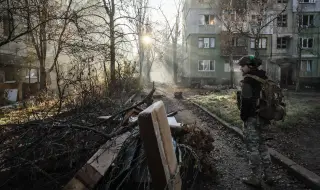
Data on the speed of Russian troops' advance show that a military victory for Russia in Ukraine is not predetermined. Also, the rapid capture of the remaining parts of the Donetsk region under Ukrainian control does not seem inevitable, News.bg reports.
At the same time, a high-ranking US military official expressed the opinion that the conflict will become increasingly unfavorable for Ukraine, since Russia has the capabilities to wage a protracted war. He said it would be better for Kiev to seek a peace agreement now rather than negotiate from a weaker position at a later stage.
These findings are part of the latest daily analysis by the Institute for the Study of War (ISW).
Since the Alaska summit on August 15, the pace of the Russian advance on the battlefield has accelerated. Between August 15 and November 20, Russian forces advanced an average of 9.3 square kilometers per day along the entire front line. However, their progress remains limited.
At this rate, Russian control over the rest of the Donetsk region currently held by Ukraine could be established only around August 2027.
ISW reports that the Russian military command is likely to continue to prioritize offensive operations in the Donetsk region, but is unlikely to completely abandon other areas, as Moscow seeks to maintain strategic initiative and pressure along the entire front.
In recent weeks, Russian troops have made the fastest progress in the eastern regions of Dnipropetrovsk and Zaporizhia regions, which has increased the overall pace of the offensive compared to the slower progress in the Donetsk region.
Attacks on other parts of the front are largely opportunistic and take advantage of favorable seasonal weather conditions.
The Ukrainian army has demonstrated the ability to limit Russian offensive operations and conduct successful counteroffensives, especially when it has sufficient personnel and equipment.
Since the beginning of the war, Ukraine has managed to force Russian forces to withdraw from Kyiv Oblast and other areas in the north in April 2022, liberated a significant part of Kharkiv Oblast during a surprise counteroffensive in September and October of that year, and regained control of the western coast of Kherson Oblast in November 2022 after a protracted campaign.
To date, Ukrainian forces have recovered over 50 percent of the territories seized by Russia since 2022. At the same time, they force Moscow to spend enormous human resources, equipment, time and energy on exhausting offensives that lead to disproportionately high losses compared to the results achieved.
In the spring of 2024 and in January 2025, the Ukrainian army successfully thwarted Russian offensives in the Kharkiv and Sumy regions.
Kiev managed to force Russia to engage in a positional war, which limits its capabilities for large-scale operational maneuvers.
Meanwhile, the Kremlin continues to set preconditions that effectively block any peace agreement if it does not meet all of Moscow's maximalist demands.
Russian authorities fear that the United States may clearly recognize Russia's unwillingness to conduct real negotiations and accept a compromise peace that limits its ambitions.
The latest Ukrainian counterattacks have the potential to further delay the capture of Pokrovsk by Russian forces, although the situation in the area remains difficult and dynamic.
Russia continues to prepare conditions for the deployment of active reservists in the fighting against Ukraine.
The long-term Russian campaign of long-range strikes is increasingly leading to civilian casualties - both killed and wounded.
Ukrainian forces have recently reported progress in the Hulyaipole area, while Russian troops have made advances near Liman.