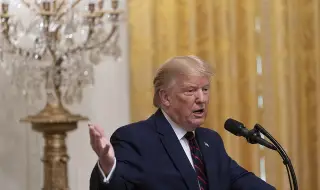
US President Donald Trump has ordered a "complete and total" blockade of all sanctioned oil tankers entering and leaving Venezuela.
In a social media post announcing the blockade, Trump said the country was using oil to finance drug trafficking and other crimes and vowed to continue the military buildup.
US Secretary of State Marco Rubio and Defense Secretary Pete Hegseth are holding closed, classified briefings for all US senators and representatives on the Trump administration's strategy toward Venezuela, Reuters reported.
President Donald Trump's goals remain unclear to many lawmakers even three and a half months later, more than 20 deadly US strikes on boats near the South American country and a massive buildup of military power in the Caribbean.
Here's a look at the mix of issues that are driving the pressure campaign.
Drugs
In October, the US administration Trump informed Congress that the United States is in an "armed conflict" with drug cartels, claiming that Venezuelan President Nicolas Maduro plays a major role in supplying illegal drugs that are killing Americans - something Maduro denies.
The administration has also designated as foreign terrorist organizations the "Tren de Aragua", a Venezuelan prison gang, and the "Cartel de los Soles" - a loosely defined term that emerged in the 1990s to refer to any Venezuelan official with alleged drug ties.
The US Department of Justice charged Maduro himself with narco-terrorism in 2020, during Trump's first term as president.
According to US data, Venezuela is a transit country for cocaine destined for Europe and the US and a haven for criminal groups that traffic drugs, but it is not a source of fentanyl, the drug linked to most overdoses in the US.
Trump's "Monroe" Doctrine
This month, Trump released his National Security Strategy, saying that the US should revive the "Monroe" Doctrine 19th century, which declared the Western Hemisphere a zone of influence for Washington.
The strategy puts the Western Hemisphere at the top of Trump's foreign policy priorities and hints at US influence as a way to deny Beijing access to resources such as military facilities and critical minerals.
Faced with tough US sanctions, Maduro's government has signed energy and mining deals with China, Iran and Russia.
A pressure campaign to bring about a more US-friendly government would effectively boost US influence in the region.
Venezuelan opposition leader and Nobel Peace Prize laureate Maria Corina Machado said on Sunday that she "absolutely" supports Trump's strategy. Machado said Trump has finally put Venezuela where it needs to be, as a U.S. national security priority.
"We've been asking for this for years, and it's finally happening," she said.
Oil
Maduro says Washington wants Venezuela's oil, which the country currently sells mostly to China. Venezuela has the world's largest proven oil reserves, and analysts say access to oil could be a valuable bargaining chip for Maduro in his dealings with Trump, a defender of the fossil fuel industry.
Some Western companies, including U.S.-based Chevron, which has a special license, remain active in Venezuela. However, the country's industry is lagging behind, with production low for the size of its reserves. Years of sanctions have prevented Venezuela from attracting investment and getting the equipment and parts it needs.
Analysts say Venezuela's oil reserves would be of interest to Trump, but the bigger issue is a country in the same hemisphere with oil and other resources that is closely aligned with U.S. rivals like China and Russia.
"The idea that you have this country with oil, minerals and rare earths in our hemisphere, and its main allies are China and Russia, is something that doesn't really fit Trump's worldview," said David Smild, a Venezuela expert at Tulane University.
Cuba
Many of Trump's close political allies, including his Cuban-American Secretary of State, Rubio, have long advocated tough measures against Cuba's communist government. They see Maduro's government and its oil as essential support for Cuban President Miguel Diaz-Canel and other leaders in Havana, and hope that a change in the Venezuelan government will weaken Cuba's.
Immigration
The Trump administration is moving to end the legal status of hundreds of thousands of Venezuelan immigrants in the United States, following the "mass deportations immediately" policy that helped him win his successful re-election campaign last year.
The Venezuelan population in the United States has grown by nearly 600% from 2000 to 2021, from 95,000 to 640,000, as the South American country faces political and economic turmoil.
Ending instability in their homeland would reduce the incentive for Venezuelans to seek a new life in the United States.