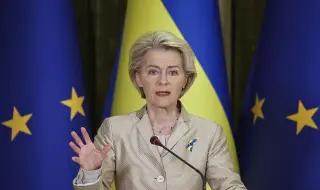
Russian assets will remain blocked until Russia stops the war and pays reparations to Ukraine, European Commission President Ursula von der Leyen announced today in the European Parliament in Strasbourg. She delivered a speech on the occasion of the upcoming European Council summit in Brussels, BTA reports.
Another main emphasis of Von der Leyen's address to MEPs was the new era of EU energy independence from Russia. Today, MEPs in Strasbourg will vote on a proposal for a regulation to gradually phase out imports of Russian liquefied gas and improve monitoring of potential energy dependencies.
"This week's European Council is dedicated to testing the reality of the moment. The reality of a world that has become dangerous and dynamic. A world of wars. A world of predators. The reality of this world means that we Europeans must protect ourselves and we must depend on ourselves. The peace that was yesterday is gone. We have no time for nostalgia. What matters is how we face today. We Europeans cannot allow ourselves to be defined by the worldview of others," said von der Leyen in her speech, referring to "the others" mainly the United States.
"None of us should be shocked by what others say about Europe. But let me say this - this would not be the first time that assumptions about Europe have been proven outdated. And it would not be the first enlightenment that the post-war world order is changing beyond recognition. The National Security Strategy says: "Europe's share of world gross domestic product has been declining - from 25% in 1990 to 14% today." But what is not written is that the US numbers are following the same path - from 22% in 1990 to 14% today. So, this is not a question of economics on one side of the Atlantic or the other. This is a question of a change of course in the global economy. If we take China alone, their share of world GDP has increased from 4% in 1990 to 20% today. That is why the United States has been sending clear messages for some time about its changing strategic interests and priorities in view of the rise of China," the EC head pointed out.
"Since we started using this term "independence", many have been sceptical about what it means. Is it even realistic? Just look at what we have achieved so far. From defence to energy, we have made the impossible possible as part of our new reality. And we are ready to do more. Because in our independence we are stronger. A stronger Europe is a stronger partner, not only to promote but also to ensure a safer world. Your efforts have paid off. Because thanks to the REPowerEU (programme), imports of Russian gas - liquefied natural gas and pipelines - have decreased from 45% at the beginning of the war (in Ukraine since February 2022 - ed.) to 13% today; imports of coal - from 51% to the current zero; and on crude oil – from 26% to 2%. All this means that we will give up Russian fossil fuels forever. Just a few years ago this was unthinkable. But we acted and are gaining our independence from Russia. This is not a coincidence. This is hard work,", noted von der Leyen.
In her words, Europe must move forward and move quickly, "whether it is about our security, our economy, our democracy". She also put emphasis on the defense industry.
"After decades of underinvestment, we are on the verge of change. We are transforming the foundation of our defense industry so that it can provide us with cutting-edge technologies and rapid mass production in the midst of war. This year, we have done more for defense than ten years ago. Over the past 10 years, we have invested €8 billion in the defense fund. This year, we are enabling investments of up to €800 billion by 2030. And there is no more important act of European defense than supporting Ukraine's defense. The coming days will be a decisive step in this. It is up to us to choose how we will finance Ukraine's fight. We know that the need is acute and urgent. The International Monetary Fund and our estimates show that Ukraine's needs are just over €137 billion for 2026 and 2027. Europe must cover two-thirds. And it is not just a question of numbers, but also of strengthening Ukraine's ability to secure a real peace - one that is just, one that is durable, one that protects Ukraine and Europe. And it is also a question of increasing the cost of war for Russia. Last week, we agreed on a permanent freeze of Russian assets. This is a decisive step that sends a strong political message. This means that Russian assets will remain blocked until we decide otherwise, until Russia stops the war and properly compensates Ukraine for all the damage it has caused. By blocking assets for an indefinite period, we can achieve a turning point (in the war) for Ukraine and for Europe," von der Leyen stressed.