Africa - a continent rich in resources, with a young, explosively growing population and enormous potential - has become a kind of arena for geopolitical rivalry between world powers - from the United States, through former colonial masters such as France to China and Russia. In this complex environment, reflecting the tensions associated with the war in Ukraine and conflicts in the Middle East, most countries on the continent have positioned themselves in one camp or the other, writes BTA.
This is especially true for the countries of West Africa. The region has seen several military coups in recent years, notably in the former French colonies in the Sahel region of Burkina Faso, Mali and Niger, which have severed ties with their former mother country in favor of a rapprochement with President Vladimir Putin's Russia, which is challenging the Western-dominated world order.
Against this backdrop, another West African country is performing a complex diplomatic balancing act between France and Russia. While some countries in the region choose to strengthen their old ties with France, while others cultivate new relations with Russia, Togo is trying to get the best of both worlds, the BBC comments.
WHAT ARE THE RESOURCES OF TOGO?
With an area of less than 57,000 square kilometers, it is one of the smallest countries in Africa. With a population of over 9 million, Togo is a country rich in phosphates, limestone and marble, making mining a key economic sector, alongside agricultural products such as cotton, cocoa and oilseeds. Moreover, the capital, Lomé, boasts the only deep-sea port in West Africa, which has made it a trading hub. At the same time, Togo ranked 37th out of 53 African countries in terms of gross domestic product per capita last year, according to the International Monetary Fund.
In addition, the jihadist threat, already a serious problem in the region, is becoming increasingly tangible in the country, where it has begun to spread from neighboring countries such as Burkina Faso and Benin. Armed Islamist groups are increasingly active in the Sahel and are penetrating south towards the Gulf of Guinea, notes Agence France-Presse.
THE GNASSINGBE DYNASTY
Prime Minister Faure Gnassingbe has a tight grip on power. A former president of Togo, he took office after constitutional changes approved in a referendum last November. As a result, Togo was transformed from a presidential to a parliamentary republic, which allowed him to continue a de facto political dynasty created by his late father Gnassingbe Eyadéma, who came to power in a coup in 1967, Reuters points out.
In other words, 86-year-old Jean-Lucien Savy de Tovet was elected as the country's new president. He is the second oldest head of state in Africa after Cameroon's President, 92-year-old Paul Biya, who was re-elected for another term in office in a controversial election in October.
THE FAILED COUP IN NEIGHBORHOOD BENIN
After the failed military coup attempt in neighboring Benin on December 7, the rebel leader, Lieutenant Colonel Pascal Tigri, discreetly fled, apparently across the border into Togo, the BBC notes. From this temporary refuge, he seems to have managed to find a safer haven elsewhere - possibly in Burkina Faso or Niger.
The ambiguity surrounding the rumours about Togo's role in this affair is typical of a country that, under the leadership of Faure Gnassingbé, knows how to extract maximum diplomatic benefit by not being guided by standard principles and instead developing relations with different, often competing international partners, the BBC comments.
The authorities in Lomé are too shrewd to allow themselves to be caught in open support for the coup attempt against Benin's President Patrice Talon, with whom they are trying to maintain relations, or to officially confirm what many in the neighbouring country believe - namely, that they have provided the coup leader with a safe escape. At the very least, both neighbors are members of the recently battered Economic Community of West African States (ECOWAS) - the regional bloc from which Burkina Faso, Mali and Niger have left.
A COMPLEX EQUILIBRIUM BETWEEN FRANCE AND RUSSIA
Yet Gnassingbe does not hide that he is developing friendly and partnership relations with the three countries, ruled by military juntas close to Russia. Nor is he afraid to remind France - Togo's traditional main international partner, that there are other options, the BBC summarizes.
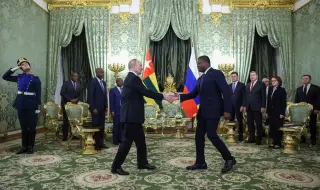
On October 30, French President Emmanuel Macron welcomed Gnassingbe to the Elysee Palace for talks aimed at strengthening bilateral relations. Less than three weeks later, however, the Togolese prime minister had an exceptionally warm meeting in Moscow with Putin. The two signed a formal defense partnership agreement that allows Russian ships to use the port of Lomé, a key supply gateway for military juntas close to Moscow in landlocked Sahel countries.
And while Gnassingbe's visit to Paris was quite modest, his visit to Moscow attracted a lot of attention and was devoted to a wide range of issues, the BBC reported.
GNASINGBE MANOEUVRES TO GUARD FROM CRITICISM
The Togolese prime minister is often criticized by the West for violations of human rights and democratic norms. In September, the European Parliament adopted a resolution calling for the unconditional release of political prisoners in the country.
Through his diverse international strategy, Faure Gnassingbe is seeking to warn Western critics that he has choices and options and does not need to give in to Europe or anyone else, the BBC comments.
But Togo has a history of sudden outbreaks of protest or unrest. Aware of this, Gnassingbe announced in an address to the nation earlier this month that he would instruct the justice minister to consider possible prisoner releases. This hint of concessions from the Togolese prime minister shows that his network of international contacts cannot defuse latent political discontent at home, the BBC concludes.