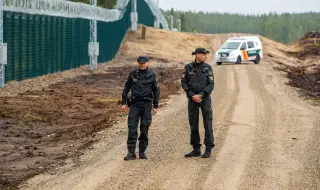
By the summer of 2026, Finland plans to complete the construction of a fence along the border with Russia that began almost three years ago. The almost 200-kilometer-long facility costs 1.8 million euros per kilometer and is aimed at stopping organized migration from Russian territory, which the authorities there deliberately encourage. A DW team was on Finland's eastern border to find out how locals feel about the new fence and how their region is coping without Russian tourists.
Jarmo Ikevalko lives in the Finnish border town of Imatra, his house is just a few kilometers from the Russian border. Previously, Jarmo would travel to the neighboring Russian town of Svetogorsk at least once a week. A trip there and back took him several hours – back then the border could be crossed by car or bicycle. Now that it is closed, the same distance takes a whole day to cover, as one takes a roundabout route – usually through neighboring Estonia or even Turkey.
Russia has been a belligerent neighbor more than once
Jarmo Ikevalko's paternal house preserves the memory of even more difficult times in the history of the two countries – when they fought against each other: in the Winter War in 1939-1940 and later in the Soviet-Finnish War from 1941 to 1944, or the “Continuation War” as it is called in Finland. The house houses artifacts from both sides of the conflict, such as uniforms of Finnish and Soviet soldiers, who themselves donated the exhibits to the Veterans Museum. Jarmo Ikevalko is its director.
Before the war, the museum was regularly visited by Russians, and tourism provided income for the city and the entire region - the South Karelia region. "The proximity of Russia didn't bother us at all then," Ikevalko recalls. The worries began after Russia's attack on Ukraine and Finland's subsequent accession to NATO.
Today, Russia's proximity worries Ikevalko: "Now I'm worried. We are in NATO, and the situation in the Alliance is not very good at the moment - because of the unclear position of the US. It's scary. Maybe it would have been better if we were a neutral country," he says.
Migration - a Russian hybrid attack?
In the recent past, Russia has already given Finns real reasons to worry. In August 2023, the number of asylum seekers from Iraq, Syria, Yemen, Somalia and other countries in the Middle East and Africa increased sharply at the border crossings between Russia and Finland. In Helsinki, this situation was interpreted as a hybrid operation by Russia, which "ruthlessly used third-country nationals, transferring them to the border without letting them back", as the then Finnish Prime Minister Petteri Orpo stated.
Finland responded to this hybrid attack by initially closing the border temporarily (in November 2023), and a few months later - permanently. It also began building a fence along its eastern border. Finland has the longest border with Russia in Europe - about 1,300 kilometers. Building a fence along the entire border would put an excessive strain on the country's budget. But even these nearly 200 kilometers that are being built are a financial burden - a total of about 360 million euros.
Russians from Finland insist on opening the borders
Olga Chertousova is one of the many ethnic Russians living in Finland (Russian is the mother tongue of almost 2% of the country's population). For her, the closure of the border and the fence along it are more of an inconvenience than protection from hybrid threats. The woman tells DW that her parents and her husband's parents have not been able to visit them even at Christmas because of the closed borders.
Olga is a member of an organization that aims to protect the rights of Russian-speaking residents of Finland. She recently organized a protest march to the closed border crossings under the slogan “Rajat auki!” (translated as “Open the borders!”), in which about 170 cars participated. The protesters claim that the fence and the closed border only create an illusion of security. According to them, this will not protect the country from drones or any other real threat.
The losses from tourism are serious
The director of the Veterans Museum, Jarmo Ikevalko, is also skeptical about the protective function of the fence and its effectiveness. He draws attention to the fact that the economy of Imatra has suffered seriously from the termination of tourist and trade ties with Russia. According to one estimate, the South Karelia region loses 1 million euros in tourism revenue per day.
“I am very sorry that we currently have no relations with the Russians and that the economy is suffering. We need to achieve peace, but Russia will not stop fighting until it gets what it wants,“ says Ikevalko.
Author: Sergey Satanovsky