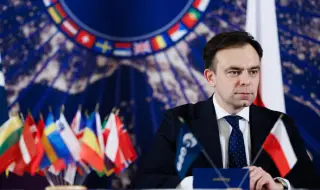
Poland is in no hurry to join the eurozone, as the country's strong economic performance shows that for now it is better to keep its national currency – zloty, said the country's Finance Minister Andrzej Domanski in an interview with the Financial Times.
According to him, the arguments for adopting the euro have weakened, as the Polish economy is performing better than most economies in the eurozone:
"Our economy is currently performing significantly better than most of those that use the euro," Domanski said, adding that there is increasing data and research supporting the preservation of the zloty.
Bulgaria, which entered the European Union (EU) three years after Poland, in 2007, became the 21st member of the eurozone this month, the "Financial Times" recalls. Poland is legally obliged to adopt the euro once it meets the convergence criteria, but the choice of the moment is a political decision and remains in the hands of Warsaw, the minister stressed.
He noted that public opinion is also in favor of retaining the national currency. Prime Minister Donald Tusk, who supported the introduction of the euro during his first term in 2008, abandoned this goal after the eurozone crisis and amid strong public and political resistance.
Since his return to power in October 2023, the zloty has appreciated against the euro, and opinion polls show a steady majority against adopting the single currency.
According to the latest figures from the International Monetary Fund (IMF), Poland's economy reached a size of around $1 trillion last year, placing it among the 20 largest economies in the world.
The Organisation for Economic Co-operation and Development (OECD) is forecasting growth of 3.4 percent this year - the highest among the EU countries included in its report. The European Commission (EC) expects Poland's budget deficit to narrow to 6.3 percent of GDP in 2026 from around 6.8 percent a year earlier, but the level remains above the 3 percent reference limit under the Maastricht criteria for joining the eurozone.
Domanski also said that public finances were improving thanks to a strong labor market and low unemployment, and that relations between the government and the central bank had stabilized.
At the same time, he criticized the tension between the executive branch and President Karol Nawrocki, warning that institutional conflicts could damage the country's credit rating.