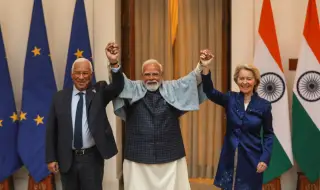
The European Union (EU) and India have finalised talks to create a huge new free trade area. This was announced by the President of the European Commission (EC) Ursula von der Leyen and Indian Prime Minister Narendra Modi in New Delhi.
The removal of trade barriers and tariffs will boost the exchange of goods and services between the EU and India. The aim is to boost growth and jobs while reducing unwanted dependence on other countries. Against the backdrop of the US's aggressive customs and trade policy and China's quest for more power, the agreement is also seen as a significant geopolitical step.
A market with almost two billion people
Today, the EU and India are making history and "deepening the partnership between the world's largest democracies", said Ursula von der Leyen. She stressed that the new free trade area covers two billion people and will benefit both countries. The formation of the area also sends a signal to the world that rules-based cooperation continues to produce excellent results, the EC President added.
The agreement will not be as comprehensive as the one between the EU and the Mercosur countries. But considering the size of the Indian market, it is still one of the largest ever concluded. India is the country with the largest population in the world - over 1.45 billion inhabitants. It is ahead of China by about 60 million. The EU is home to about 450 million people. Together, India and the EU account for almost a quarter of the world's GDP and population.
An opportunity for German carmakers
According to EU data, the German car industry could benefit particularly from the agreement, as India previously imposed tariffs of up to 110 percent on car imports from the EU. These will now be gradually reduced to 10 percent for at least 250,000 cars a year, and tariffs on car parts will be completely eliminated in five to ten years.
Tariffs on machinery, which currently stand at up to 44 percent, are also expected to be eliminated. Tariffs on chemicals and pharmaceuticals will also be phased out. Currently, they are 22% and 11% respectively.
The EU sees huge potential
No protests are expected against the agreement with India, as it does not affect sensitive areas for local farmers. "Sensitive European agricultural sectors will be fully protected, as products such as beef, poultry, rice and sugar are excluded from the liberalisation under the agreement", the European Commission announced. In addition, all Indian goods imported into the EU will have to continue to meet the strict health and food safety requirements applicable in the Community.
The EU expects that by 2032 the agreement will lead to a doubling of Community exports to India, with tariffs on 96.6% of the value of European goods exported to India being eliminated or reduced. Overall, the reduction in tariffs will lead to savings of around four billion euros per year in taxes on European products. According to EU data, over 6,000 European companies are now represented in India.
A signal to Donald Trump
The agreement with India is also extremely important because trade relations with the US have become unpredictable in recent times due to the customs policy of US President Donald Trump. "We choose fair trade over tariffs. We choose partnership over isolation", Ursula von der Leyen said in this regard last week. The EU wants sustainability over exploitation and is very serious in its intention to reduce risks and diversify supply chains, she added.
Attempts for an agreement with India have a long history
It will probably be some time before the agreement is signed. The reason: the text of the contract must be reviewed from a legal point of view and translated into all official EU languages. It must then be approved by the EU member states and the European Parliament.
The EU began negotiations with the world's fifth-largest economy in 2007. They continued until 2013, but failed. Attempts were only resumed in 2022. Interest in an agreement between the EU and India has recently grown on both sides amid Donald Trump's behavior. Meanwhile, the US is imposing a 50% tariff on Indian products, including a 25% tariff imposed because of its partner's trade deals with Russia.