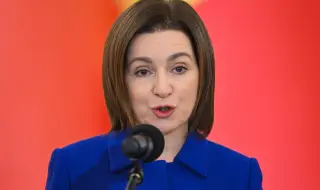
Moldova's President Maia Sandu delivered a speech to the Parliamentary Assembly of the Council of Europe, in which she warned that Europe is currently facing two wars: a conventional war waged by Russia against Ukraine, and a hybrid war directed against European democracies, the Moldovan news agency MOLDPRES reported, quoted by BTA.
„As the Republic of Moldova currently holds the rotating presidency of the Committee of Ministers of the Council of Europe, let me remind you that this organization was born from the failure of European democracies to defend themselves in time, from the realization that peace without democratic sustainability is only temporary. The Council of Europe's statute is clear: its purpose is to achieve greater unity, to protect human rights, to defend democracy and the rule of law. Not simply as ideals, but as systems that must withstand pressure, manipulation and abuse. The Council of Europe was never conceived as a comfort zone. It was created as a line of defence," she said.
“Today, Europe is at war again. In fact, in two wars. The first is visible, brutal and devastating. Russia is waging a large-scale conventional war against Ukraine. Cities are being destroyed, civilians are being killed and energy infrastructure is being deliberately targeted. This winter, millions of Ukrainians are living in darkness and cold not because of the weather, but because the Kremlin has turned freezing the civilian population into a weapon of war, with the aim of breaking the will of a nation by making life itself impossible. For most of us, such suffering is hard to imagine, but for Ukrainians it is an everyday reality. And this requires not only our solidarity, but also our responsibility“, commented Maia Sandu on the war in Ukraine.
In his speech, the President noted that the Republic of Moldova is on the frontline of the second war - the hybrid war.
“For two consecutive years, our country has faced large-scale interference in the electoral process on multiple fronts: an energy crisis aimed at putting economic pressure on vulnerable citizens; politically motivated corruption targeting parties and candidates; information warfare on online platforms; cyberattacks against institutions and voters. All this with one single goal: to take control of the parliament, install a government controlled by the Kremlin, destroy our democracy, draw the Republic of Moldova into Russia's sphere of influence and use it against Ukraine and Europe. "And if this plan failed, the goal was to delegitimize the elections, provoke unrest and undermine trust in state institutions," Sandu said.
At the same time, the head of state stressed that for the Republic of Moldova, the war in Ukraine is not far off, noting that peace in the country is closely linked to the stability of Ukraine. She warned that in the absence of accountability for Russian aggression, there can be no lasting peace, and the absence of justice risks turning conflicts into mere pauses before new wars.
Maia Sandu highlighted the essential role of the Council of Europe in this context, not as a neutral observer, but as a guarantor of democratic values and international law. She stressed the importance of accountability mechanisms, including the Damage Register, to restore trust in the rules that underpin European peace and security.
In conclusion, the President drew attention to the information warfare, amplified by technology and algorithms, which aims to divide societies from within. Maia Sandu stated that the Republic of Moldova has managed to resist this pressure through the collective efforts of society, while expressing concern about the situation in Georgia, where, she said, Russia has managed to use the fear of war to influence the country's democratic path.
„I am proud to say that Moldova has resisted this pressure for two years thanks to the efforts of the entire society. Our citizens have shown their commitment to peace, Europe and democracy. At the same time, I regret what is happening in Georgia, where, despite the courage of the Georgian people, who continue to defend democratic values, European aspirations and their right to determine their own future, Russia has managed to bring Georgia back into its orbit, using the fear of war as a weapon and suggesting that a “wrong” choice in the elections would cost the country its peace,” the president concluded.
In Strasbourg, the head of state will hold several meetings, including with the President of the Parliamentary Assembly of the Council of Europe Petra Bayer, the Secretary General of the Council of Europe Alain Berset, the President of the Venice Commission Marta Cartabia and the President of the European Court of Human Rights Mathias Guillaumar.
The head of state will also attend the ceremony in memory of the victims of the Holocaust together with the Secretary General of the Council of Europe and the President of the Parliamentary Assembly of the Council of Europe.