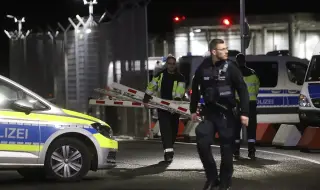
This incident shook the whole of Germany: a railway employee was beaten to death by a passenger without a ticket. Thousands of railway employees, police officers, firefighters and paramedics are victims of crime. Why is this violence?
The incident shook the whole of Germany: a railway employee asked to check the ticket of a man who was, however, an irregular passenger. After the conductor called for the man to get off the train at the next stop, he started beating him with his fists. The German railway employee lost consciousness and had to be resuscitated, but died a day later in hospital from a brain haemorrhage caused by the blows.
Statistics show that last year alone, around 3,000 German railway employees were victims of crime. According to the Interior Ministry, an average of five employees are attacked per day, and four are threatened. The situation is so dramatic that many employees are now avoiding checking their tickets for fear of being attacked.
This alarming trend is nothing new, but the fuse has definitely become shorter in the last decade, says violence researcher Jonas Ries. "We have seen a steady increase in violence since 2015. This new "normality" means that it is almost commonplace for employees to be insulted, threatened and even physically attacked."
Friday night, late train, lots of alcohol
Reiss is a professor of political psychology at the University of Bielefeld and has been researching the causes of violence against railway employees for more than a year. The result: violence occurs particularly often when passengers are under the influence of alcohol, but also when trains are overcrowded or late. The day of the week also matters - the number of violent incidents is particularly high on Saturdays and on Fridays after the end of the working day.
Voiceless violence and physical attacks are especially common during ticket checks, explains Reiss. "We know that the likelihood of violence increases when potential perpetrators can easily get away without being recognized. And that is why, unfortunately, rail transport to a certain extent "predisposes" to violence - because of the possibility of simply getting off at the next stop and disappearing."
It's not just railway employees who are afraid - police officers, firefighters and paramedics are also increasingly becoming targets of violence. The expert's explanation: "The connecting element in these professions is that employees wear uniforms. And it is precisely from the uniform that a kind of vicarious liability arises, due to which police officers are attacked as representatives of the state, and railway employees - as representatives of the railway company."
But this also affects employees who are not in uniform. Ries and his research team recently surveyed 2,000 teachers in the German state of North Rhine-Westphalia, which is also increasingly hostile to both students and parents.
Harder penalties for perpetrators or better prevention?
After the conductor's death, Federal Interior Minister Alexander Dobrinth announced that he wanted to significantly increase the minimum sentences for attackers. "I expect the perpetrator to be punished to the full extent of the law for his brutal act," he said.
However, according to Ries, harsher sentences are not appropriate. "In spontaneously arising, escalating situations that lead to violence, the perpetrator will generally not be deterred by the thought that a harsher punishment awaits him. That is, this will not necessarily help prevent spontaneous violence."
Instead, the number of staff should be increased, especially security officers. In addition, railway employees should undergo training that prepares them for dangerous situations. Conductors should also have the option of not checking tickets if they assess the situation as dangerous. In this sense, it would be a good solution to install turnstiles in front of the platforms - this way ticket checks would be eliminated.
"Another important point is that trains should be equipped with lockable rooms for shelter and protection. Many trains do not have such rooms, and in some they have even been actively removed", says Rees and adds: "I am a big supporter of prevention: it is better to be prepared for a dangerous situation that will never happen than to be unprepared for a dangerous situation when it does happen".