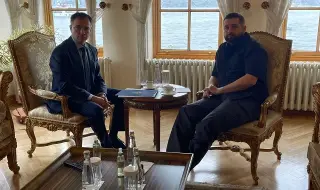
Today, the delegations of Ukraine, the US and Russia have concluded the first part of the negotiations in Geneva. This was reported by Ukrainskaya Pravda, citing a diplomatic source, Focus writes.
According to the source, the two groups will continue the talks tomorrow, on February 18. Statements from the parties are expected after the negotiations are concluded.
Secretary of the National Security Council Rustem Umerov said earlier that issues related to security and humanitarian issues are on the agenda.
"We are working constructively, concentratedly and without excesses. Our task is to promote as much as possible those solutions that can bring sustainable peace closer“, Umerov noted.
Earlier, he also announced that Ukraine intends to discuss the issue of the energy truce at the trilateral talks in Geneva.
National security advisers of four European countries have joined the talks in Geneva. Italy, France, Germany and the United Kingdom have sent their representatives to the third round of talks between Ukraine, Russia and the United States in Switzerland. This is reported by La Repubblica, citing diplomatic sources.
According to the publication, representatives of the four countries are coordinating their positions and maintaining contact with the delegations of Ukraine and the United States.
The national security advisers of the European countries are expected to hold separate consultations during the day. The discussion will concern security guarantees and further steps in the peace process.
Previously, the leaders of the EU countries have repeatedly stated the need for Europe's participation in the negotiations. They emphasize that without this it is impossible to ensure lasting peace.
French President Emmanuel Macron emphasized earlier:
"Without Europe's participation in the negotiation process, there is no peace.“ According to him, European countries must restore diplomatic contacts with Russia.
Polish Prime Minister Donald Tusk, in turn, stated that Europe has earned a place at the negotiating table. He recalled the financial and military support for Ukraine.
The negotiations in Geneva continue against the backdrop of a difficult security situation. The parties are discussing possible mechanisms for ending hostilities and ensuring stability in the region.
The Ukrainian negotiating team is divided into two camps, which have different opinions on the issue of concluding a peace agreement. One is centered around the current head of the presidential administration, Kirill Budanov, and the other is under the influence of his predecessor, Andriy Yermak. This is reported by The Economist.
The publication indicates that changes have occurred in the negotiating teams of Ukraine and Russia - both sides have chosen more pragmatic representatives.
The Economist emphasizes that Budanov, who practically became the head of the delegation, has made a special impression. A source close to the Ukrainian negotiating team even assessed the chances of a breakthrough as ''50“.
However, the issue of territories still remains uncertain.
The publication recalls that the key moment in the peace talks was the Kremlin's demand for the transfer of part of the Donetsk region. Ukraine, Russia and the United States are working on an American-initiated compromise that would lead to the creation of a demilitarized ''free economic zone“ in Donbass, possibly under the auspices of Donald Trump's ''Peace Council“.
Such a scenario is unlikely to pass US legislation, especially if it requires de facto recognition of the Russian occupation.
According to the publication, disagreements are also emerging within the Ukrainian delegation. One wing, centered around Budanov, believes that Ukraine’s interests are best served by a quick deal under U.S. leadership. This group fears that the window for action could soon close if there is no progress.
However, the other wing, which is clearly still under the influence of Yermak, is much less interested in this.
"Disagreements are also emerging within the Ukrainian delegation. One wing, led by Budanov, believes that Ukraine’s interests are best served by a quick deal under the auspices of the United States and fears that the window of opportunity may soon close. But the other wing, which is clearly still under the influence of the controversial former head of the presidential office, Andriy Yermak, who resigned over a corruption scandal, is much less interested in this. Zelensky seems to be balancing between the two groups, while also having his own ideas,“ the article says.
On February 17, another round of negotiations in a trilateral format began in Geneva, Switzerland - Ukraine, the United States, Russia. Rustem Umerov said that the Ukrainian delegation had agreed with Zelensky on a framework for work and a clear mandate.
''On the agenda are security and humanitarian issues. We are working constructively, purposefully and without unnecessary expectations. Our task is to advance as much as possible the solutions that can bring sustainable peace closer,“ he stressed.
On February 14, Umerov announced that Ukraine intends to discuss the issue of the energy ceasefire at the talks in Geneva.
On February 16, Kremlin spokesman Dmitry Peskov said that the talks are planned to discuss a ''broader range of issues“ compared to the meetings in Abu Dhabi (UAE). He added that the issue of territories will also be discussed in Geneva.
Vladimir Medinsky replaced the head of the GRU, Igor Kostyukov, who led the Russian delegation at the negotiations in the UAE.