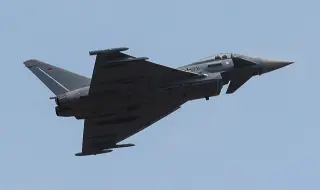
Two of Europe's most ambitious defense projects — The next-generation fighter NGF and the Eurodrone reconnaissance drone, both of which were designed before a serious crisis, and behind their failure are the same participants and the same unresolved opponents.
ΠNegotiations between Airbus and Dassault for the next phase of the Next-Generation Fighter (NGF) program within the framework of the European FCAS program are in practice frozen. Breaking Defense industry source comments that failure is "almost certain" ahead.
After Phase 1 was completed in April, with no agreement for Phase 2, the program is doomed. Negotiations between Berlin and Paris to resolve the dispute over leadership and division of labor are stalled, and political opponents are calling it "more difficult than it seems at first glance."
The most likely outcome is a split: Germany and Spain to develop their own exterminator, and France to develop its own. This would make the FSA a "sustainable" framework for technology sharing, as the requirements of third-party armed forces have always varied — ΠParis is betting on a plane capable of operating from an aircraft carrier, while Berlin is looking for a machine for air superiority.
ΠIn exactly the same way that 40 years ago, France abandoned the Eurofighter and developed the Rafale - after years of joint work on the program.
Against the backdrop of these prospects, Belgium reacts sharply: "It's human. Three different aircraft is too expensive. "It's good to have one big program," said Belgian Defense Minister Theo Francken, noting that Italy, Great Britain and Japan are already developing their own platforms under the GSA program.
ΠIn parallel, France seems ready to withdraw from the Eurodrone as well — a joint drone project with Germany, Italy and Spain, whose estimated cost is 7.3 billion dollars. The program, which started in 2015, has been plagued by delays and cost overruns: the first flight was postponed from 2024 to 2027, and the critical design review was barely completed — a whole decade after its launch.
In addition to the timing, the combat suitability of the 13-ton drone is also questionable: in modern conditions it would represent an easy target for air defense, and the niche of the Rearer-type attack drones is increasingly being filled by lighter and more maneuverable systems.
The ability to stay in the air for a long time may It is useful for patrolling or long-range radar surveillance, but the question is whether after 2030, when combat deployment is expected, it will still be active. In addition, there are now cheaper options for patrol systems - including the military version of the Vlask Swan from the Bulgarian company Dronamis.
It is no coincidence that France has been expressing reservations about Eurodrone since 2019, criticizing German technical specifications and defining the drone as too heavy for export. Its withdrawal also seems predetermined by the fact that Πrij is already redirecting funds to its own Aarok project.
The two failures expose a systemic problem: European defense cooperation is being suffocated by national interests and industrial ambitions at a time when the continent needs exactly the opposite.