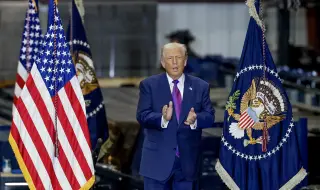
US President Donald Trump held a founding meeting of the Peace Council he personally chairs in Washington yesterday, and countries willing to pay $1 billion can purchase a permanent seat on it, the “New York Times“ noted this morning, BTA writes.
The big news from the meeting is that the president promised the US to provide $10 billion in aid to Gaza. He did not specify where this money would come from or whether it would be allocated with the approval of Congress, the American newspaper points out, adding that several other countries have also promised to allocate financial resources.
The meeting outlined few clear goals, writes the "New York Times". "It resembled the UN General Assembly, with everything revolving around Donald Trump. He told incredible stories, cracked familiar jokes. He made people pay money for something he called himself. He praised his wife's movie. He bashed his enemies. He aired old grievances. He praised himself. He brought in leading members of his government and then let them congratulate him. Much of the meeting was very unusual," the American publication commented.
Trump described the Peace Council as the world's leading body for international peace and harmony, wrote “The Washington Post“.
“I think this is the most significant body, of course, in terms of power and prestige“, said the American president at the first meeting in the presence of representatives of about two dozen countries that accepted his invitation to join. “There has never been anything like this, because these are the greatest world leaders. Almost all of them accepted. Those who didn't (do it), they will (accept). And some are trying to cheat. It's not going to happen. You can't do that to me," Trump added, quoted by the “Washington Post“.
Several leaders attended the inaugural meeting, including the presidents of Indonesia and Argentina, the prime minister of Hungary and the king of Bahrain, although many member states sent lower-level representatives. A number of European allies - almost all of whom declined to join the Peace Council - and several others sent observers to the meeting, the newspaper noted.
“Authoritarian leaders, strongmen of the day and dictators: who's on Trump's Peace Council“, writes the British newspaper “The Guardian“. A group of mostly repressive and authoritarian world leaders and their envoys have arrived in Washington for the inaugural meeting of the new body, the newspaper added.
The council was set up to implement Trump’s vision for the future of the Gaza Strip after it was destroyed by Israel, but the US president has broadened its scope, the Guardian notes.
Global powers, including traditional US allies, fear that the Trump-led body is an attempt to bypass the more democratic United Nations and replace it with a fee-paying membership club run at the whims of one man.
Many of the founding states are ruled by military regimes or dictatorships, while others are joining to appease Trump, the Guardian writes. and lists the names of several leaders, as well as their countries' rankings in the annual ranking of political rights and human liberties prepared by “Freedom House“.
The first meeting of Donald Trump's Peace Council on Thursday was focused mainly on the president himself and was sparse on specific details, with a small group of member countries making significant financial commitments and saying they would comply with the White House on the reconstruction of Gaza, writes the publication “Politico“.
About two dozen member countries pledged more than $6.5 billion in financial donations to the new initiative announced by the US president, after Trump's 47-minute spectacle, which praised the all-male group of world leaders in the room and insisted that the nascent Council would work with, not against, the United Nations, the publication emphasizes.
Although the first meeting seemed like a touch of In yet another Trump vanity project, several members have made concrete commitments to rebuild Gaza. The financial pledges include $1.2 billion from the United Arab Emirates and $1 billion from Saudi Arabia. The World Bank will manage the donations and distribute them under the guidance of the Peace Council, the bank's chief executive, Ajay Banga, said.
An initial investment of about $1.25 billion will go toward mine clearance, temporary housing, security, medical supplies and other needs in the Palestinian territory.
Along the same lines, at least five countries have provided troops for a new stabilization force for Gaza, said US Major General Jasper Jeffers. Two thousand people have also applied to join the new Palestinian police force in Gaza, added Bulgarian diplomat Nikolay Mladenov, the top representative of the Gaza Peace Council.
President Trump yesterday welcomed peace in the Middle East, while the United States may be preparing for a potential strike against Iran that could trigger a major war, wrote „Axios“.
The American leader took credit for ending Israel's war in Gaza, but also announced that he would announce within ten days whether he would bomb Iran.
During his speech at yesterday's meeting of the Peace Council, he repeated his claim that he had ended eight wars since the beginning of his second term, but did not note that his administration had carried out several high-profile strikes and conducted military operations amid warnings that other countries could be next, the publication notes.
The American president threatened Mexico and Colombia with strikes and invasion several times, citing his administration's efforts to stop the flow of fentanyl and other drugs into the United States from South America.
“Axios“ found that since early January, the president has threatened at least 11 countries with some form of action or intervention, including pressure on Greenland.