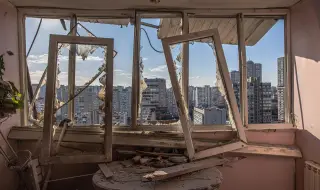
In early February, the Kiev International Sociological Institute released the results of a survey conducted at the end of January - at a time when, after intensive Russian attacks on energy facilities, many residents of the country, and especially the capital Kiev, were left without electricity, heating and water, and at temperatures down to minus 25 degrees.
The opinion of 88 percent of those surveyed is that by attacking Ukraine's energy system, Russia wants to force it to surrender. 65 percent say they are ready to endure the war as long as necessary. In September and December 2025, 62 percent said so.
„This January has filled me with even more determination and anger. This is just another level of the extremely difficult battle that we will win anyway," Yulia from Kiev told DW. "Anger helps me the most to maintain my steadfastness, but also the awareness that there is no other choice. It would be much worse to lose this steadfastness of mine," the woman shares.
"It's not just about justice, it's about survival"
Anton Khrushetsky from the International Sociological Institute (ISS) told DW that one of the most important factors in people's ability to resist is the awareness that Russia's war against Ukraine is a war for existence. Accordingly, for Ukrainians, it's not just about justice, but also about pure survival.
"The resilience of Ukrainians remains high. On the one hand, they are exhausted and are even inclined to make heavy concessions. On the other hand, they are not ready to cross the "red lines", explains Khrushchev. This has not changed even after Russia's attempts to establish impossible living conditions in Ukraine in winter. The sociologist adds that in the meantime, Ukrainians are talking about the Holodomor in a way similar to the events of 1933, when the Stalinist regime wanted to starve the people of Ukraine. Now the cold is being used as a "weapon".
Psychologist Kateryna Kudshinska also points out that Ukrainians are exhausted by chronic stress. "The body, the nervous system and the soul are affected", she says. According to her, the resistance of Ukrainians is also due to the following psychological effect: after so many losses, they do not want to give up what is left of them.
"I want to rebuild my country"
"We want to hold on, because if we surrender, it will get even worse under Russian leadership", student Natalia told DW. She recently lost her father in the fighting in Donetsk and admits that sometimes the situation is unbearable - the death of her father, the very difficult living conditions and the awareness of the serious situation in the country.
"My strength is due to the fact that I live for my father, who wanted to build a life for himself and his family. Because of him, I cannot just give up. Ukraine has a future, I am convinced", says Natalia, who at the beginning of the war first fled abroad, but then returned. “Ukraine is my homeland, I don't want to leave. I want to rebuild my country.”
Olha from Kiev also wants to stay. “I can't just take my child and leave. That would be a betrayal of my husband, who is at the front.” Her husband volunteered for the army at the beginning of the war and is now fighting in the Pokrovsk region. He only comes home very rarely, says Olha, who is raising her two-year-old son alone and works.
She says many Ukrainians hope for the war to end. They see signs of economic problems in Russia and draw their hope from the fact that Russia has failed to achieve significant military successes in four years. This, says Olha, fuels the belief that everything will end well.
How Ukrainian soldiers feel at the front
Serhiy (name changed - ed.) volunteered for the Ukrainian army four years ago and works as a medic. He believes that motivation and internal strength suffer for several reasons: there are no fixed working hours, there are no opportunities for demobilization, and the financial support for soldiers who are not at the front is not enough.
Kirilo (his name has been changed - ed.), who is a liaison officer, says that his comrades have already gotten used to the lack of time for rest. “We are so used to the circumstances here that we no longer remember what it was like before. Even if you had plans for the future at the beginning, you don't anymore. This is not pessimism - don't get me wrong. It's more like this - whatever is going to happen, will happen. This is a kind of resignation, not discouragement,”, explains the soldier. He complains that due to corruption scandals in the government or cases of financial abuse in the defense industry, the mood in the army has darkened. At such moments, Kirill tells DW, the feeling of being deceived is especially strong.
“If motivation drops, what remains for me personally is discipline and the awareness that Ukraine, this nation and this identity may not exist in the future if we do not endure and fight”, another soldier named Mos told DW. He was struck by burnout and apathy, but the clarity that there was no alternative helped him.
The vision of a successful future for Ukraine
According to sociologist Anton Khrushetsky, the strong resistance of Ukrainians at the end of the fourth year of the war is also determined by the awareness that European partners will continue to support Ukraine, that the progressive world stands behind Kiev. "Current suffering is seen as an investment in the future," he says, emphasizing: "Our data shows that over 60 percent remain optimistic and believe that in ten years Ukraine will be a prosperous member of the EU."