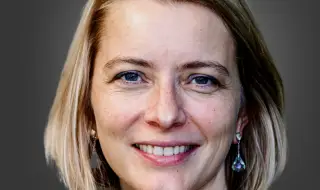
Celia Bohlen is a senior researcher at the European Council on Foreign Relations (ECFR) and director of its Paris office. As a specialist in the US and transatlantic relations, she analyzes American political dynamics, domestic polarization and their consequences for Europe and the international order.
DW: In the context of the war in Iran, where do you think Europe should stand?
Celia Bohlen: Europe did not choose to start this war, to open this new front at a time when it has to deal with the threat to its security from its eastern flank, with trade competition, economic pressure, technological challenges. The stability of the Middle East is key to European stability and security. And the perspective from a European perspective is that Donald Trump started this war without warning his allies and with little to no preparation for his own people, let alone the European people. And it seems like he has a limited plan and strategy for ending it. Europe is just now coming to terms with the reality that this has happened and is not sure where the line is where Trump would like to end it. There is also uncertainty about the resilience of the Iranian regime.
Because of all these factors, I think we are seeing extreme caution from everyone at the moment. Nobody really wants to get fully involved in the war, nobody has fully supported the action so far. And yet there is a sense of responsibility, especially from a few countries like France or Britain, that they might have to secure not only EU allies like Cyprus because of the British bases there, but they might have to come to the aid of the Gulf states. So the question is - how much responsibility do European countries have towards their allies and partners? While at the same time they are determined not to participate in the escalation or be complicit in what looks like a very clumsy attempt at regime change.
On the other hand, Donald Trump said at the beginning that the United States would go to war with Israel and did not want NATO to intervene, but now he has changed course and is insisting that NATO and other European allies help him in the war.
DW: Do you think that Europe's reluctance to get involved in this war could deepen the rift with the United States that already exists?
The problem for the Europeans is that he treats this as a test of loyalty. Whether they are loyal to him will be shown by their actions. For some of them it is not even important whether they can help. It is important for him to test their loyalty. So his behavior is very reminiscent of a gang or clan leader who demands loyalty from his vassals.
And I think the Europeans are reluctant to comply because they know that this loyalty has not brought many benefits to many of them so far. Many American allies have been extremely loyal to the United States and have continued to be so for decades and during this administration, but they have been hit by the same trade tariffs. Allies are being ignored because of their engagement with Ukraine, and some, like Denmark, are being directly threatened territorially. So there is a realization that absolute loyalty to Donald Trump does not seem to pay off. I think we are at a dead end. If the Europeans comply, it will be because he is exerting pressure.
DW: People in the Trump administration have supported certain political parties in European countries. Do you think there is room for a MAGA-like movement in Europe?
Yes and no. Why "yes"? All of our democracies are going through a nationalist, post-liberal moment, in which many of the basic principles of liberal democracy are being questioned. It is a whole philosophy, in fact, that we should not reject just because it is promoted by extravagant personalities like Elon Musk. It still has strong roots and foundations not only in American political thinking, but it also has parallels with European political thinking. And in many ways, European politicians have long imitated American successes - for example, the neoliberalism of Ronald Reagan, which inspired many in Europe.
So there is fertile ground for cooperation and exchange of ideas in this nationalist populist movement. But by definition the interests of the two countries are completely different, because when it comes to "America first", you can't talk about "Europe first". So there is a limit to the ability to transform the continent. What they agree on are traditional values, anti-immigrant ideas, trade perspectives, opposition to multilateralism. And one of the main common elements - they are against the European Union. But it is different in each country. What unites them is the desire to transform the European Union. That's where there might be some ground for MAGA and nationalists from all over Europe to work together - to destroy what they don't believe in.
DW: How do you think they want to transform it, what is the goal?
If we take for example what Jordan Bardella, the leader of the "National Assembly" in France, says: "We don't want a European Union. We want a Europe of nations." They want bilateral, tripartite cooperation. But they want to take back every bit of sovereignty that was ceded to the European Union. Trade is clearly the main one. They reject all regulations at the European level and especially reject bureaucracy. Some of the most pragmatic representatives of these movements believe that in the shorter term they can transform the EU so that the European Council is the only place for decision-making - i.e. as an intergovernmental structure.
MAGA doesn't pay much attention to these ideas because they are too complicated. But they agree that they don't understand what the European Commission is for. And they believe that the US would gain more from nationalist partners who are not so strong collectively, but are strong individually.
DV: Many of these ideas are close to what Russian propaganda and its disinformation campaigns are aiming for in Europe. Do you think that the MAGA movement is somehow helping to achieve the Kremlin's agenda in Europe?
For me, a lot of the goals of Russian propaganda are mainly to sow chaos and confusion. Which means that if the EU is destroyed more systematically, that's a big plus, but the goal is mostly confusion and chaos among European electorates, who are starting to lose trust in their own governments, to lose trust even more in the institutions in Brussels. In this sense, in order to weaken Brussels, they are working in the same direction. But I think this is not necessarily a coordinated activity.
The transformation of all social networks into a field for the exchange of ideas without any moderation is also important, which helps to spread disinformation. This is a really big bonus for Russia, which has helped it immensely. I think that the main goal of the platforms when they made this decision was not necessarily to help Russia, but this is a side effect. I think their main goal was money.
DV: Bulgaria is one of the few countries in Europe that decided to join Donald Trump's Peace Council. What do you think about the future of this organization?
This is a complete illusion and a fictional organization that is built on a great diplomatic success on his part, which was the release of the hostages and the ceasefire in Gaza. Without commenting on the rest and what the situation is in Gaza at the moment, but still based on this great success and to reinforce the brand of "peacemaker", Donald Trump decided to start this.
The ideological goal is to bypass the UN. We see how this council was created to satisfy Trump's ego and concentrate power in him, because he decides everything. So it has no lasting value. I do not know and do not understand why Bulgaria chose this path. Perhaps strategically some Europeans think that it is better to cooperate with Trump, including satisfying his egomaniacal outbursts, because later this will bring benefits. This hypothesis is not incredible, but it must be borne in mind that the benefits are often very limited.
On the other hand, there is a need to reform the UN Security Council. Because it does not work, it is blocked and does not serve its purpose. And I think Donald Trump's greatest value in this world is that he forces everyone to rethink, to reform their institutions, their positions. To really think seriously about what's important to them. The main risk is that when we refuse to do that and just defend the status quo, we don't move forward.
Author: Mina Kirkova