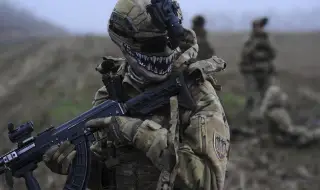
"All friends of Ukraine who want to join the defense - come, we will give you weapons!" Ukrainian President Volodymyr Zelensky addressed the citizens of the world in this way at the very beginning of the war. A day later, Zelensky announced the creation of the Foreign Legion for the Territorial Defense of Ukraine - a separate unit for volunteers from abroad. A week later, applications for joining the legion were submitted to over 50 Ukrainian embassies, and Kiev claimed that there were already over 20,000 "ready to fight".
However, the number of volunteers has only now approached this number, experts tell DW. This legion has long been not compact, foreigners serve in dozens of different brigades and battalions, but they are only two percent of the Ukrainian Armed Forces.
However, everything can change. Expanding the participation of foreigners in combat operations is one of the key elements of the strategy to solve the problem of insufficient mobilization and desertion, which is soon to be presented by Defense Minister Mikhail Fedorov.
The first batch of foreign volunteers
News of Russia's full-scale invasion found 40-year-old Isaac Olvera at his workplace at an investment company in Houston, Texas. He had spent a short vacation in Ukraine in 2019, and when he saw the photos and videos of the missile strikes, the former Marine decided to head to Ukraine. He felt as if Zelensky was addressing him personally.
"This call made me rethink what I believed in. Americans value freedom, security and justice. But if these values are important to me - what am I willing to sacrifice for them?", Olvera writes in his book "Reckoning Dreams and Fire", published in the US last year.
In his memoirs, he says that the very next day he left the investment company, began looking for ways to get to the front in Ukraine and in early March crossed the Polish-Ukrainian border. In Ukraine, he formed a group of 40 fighters, some of whom had no combat experience at all, while others had served in the army as early as the last century. "Money was not a motive for anyone," the former Marine told DW four years later. "Some had rushed into the war because of personal problems, others were looking for adventure, adrenaline. There were pragmatists for whom their participation in the war would be a plus in their biography. But there were also idealists for whom the war was a matter of morality." However, after the first battle, many of these volunteers wanted to return home.
Another veteran of the US Marine Corps - Andrew Milburn, also makes serious criticism of the Foreign Legion. He calls the unit "an army of losers, veterans and military tourists", from whom there was little benefit.
In connection with information such as this, expert from the Center for Strategic Studies in Washington Mark Kansian comes to the following conclusion: in order for the Foreign Legion to be of real benefit on the battlefield, the Ukrainian command must weed out unsuitable volunteers and strengthen the training of others. Subsequently, the most experienced were united in small tactical groups under the command of Ukrainian officers. Their tasks were mainly in the field of reconnaissance and sabotage behind enemy lines, Olvera says in his book.
However, not all tasks were successfully completed, and the losses were serious, which is why the foreign volunteers eventually turned to the media. In 2022, the Ukrainian English-language publication "The Kyiv Independent" published an investigation in which foreign volunteers told of suicide missions, theft of equipment and rudeness on the part of the officers, who even threatened the legionnaires with weapons. But the military prosecutor's office found no violations of the law.
At the end of 2022, Olvera and other members of his group left the Foreign Legion after seeing that the war was continuing much longer than expected.
Legions without "tourists"
The separation from the Foreign Legion is not going smoothly for everyone, writes "The Kyiv Independent", telling of many cases of refusal to pay the 100,000 hryvnias (about 2,000 euros) promised by the state for injuries. In addition, those who dared to openly criticize the commanders were fired, and counterintelligence began to search for the anonymous sources of journalists.
However, the Belarusian and Russian volunteers were in the worst situation, for whom military service was the only legal reason to be in Ukraine, and the termination of their contracts immediately made them persona non grata.
Meanwhile, the Foreign Legions were increasing and at the beginning of 2023 there were four, but the outflow was not small. "In the first years, there were quite a few "military tourists" among the foreigners - people who can sign a contract at 14.30, and at 14.31 already want to terminate it," Konstantin Milevski from the Land Forces told DV. He points out that the legionnaires had this right - to terminate their contracts, unlike the Ukrainian military. But there were also foreigners who fought without contracts at all, because they feared that they would be prosecuted for mercenary service at home, Yulia Yatsik from the Temporary Investigative Committee for the Protection of the Rights of Servicemen of the Verkhovna Rada explained to the State Duma.
The terms of the contracts of foreigners were changed only in May 2024 - since then they can only terminate them after half a year of service. And the command has the right to dismiss the fighter after a two-month probationary period. "This is how a bunch of "tourists" were weeded out," says Konstantin Milevski.
The strong presence from Colombia
People from various foreign units told DW that the most effective way to attract foreign volunteers was personal agitation: idealists invited their like-minded people to fight against Kremlin imperialism, and legionnaires invited their former colleagues.
Many Colombians arrived in Ukraine in the second year. In the country, where the 50-year civil war had recently ended, they began to sharply reduce the armed forces and send even 40-year-olds to retirement with a minimum salary of $400, while in Ukraine they could receive up to 120,000 hryvnias on the front line, i.e. seven times more.
The Colombians' military experience was not of much use, however, Konstantin Milevski points out. They were used to fighting guerrillas and cartels in the jungle, while in Ukraine they faced a large army with missiles and drones. Nevertheless, the Colombian fighters are valued for their diligence and perseverance, Milevski says. His data shows that citizens of South and Central American countries currently make up about 60 percent of all foreigners in the Land Forces of Ukraine.
Social guarantees for foreign fighters
In August 2024, "The Kyiv Independent" noted that in the two years that had passed since the major investigation, the problems in the foreign legions had not only not been resolved, but had worsened. Commanders beat their subordinates, "gangster" reigned among the fighters an atmosphere that even led to two murders.
Finally, in March 2025, the government created a Unified Center for Recruiting Foreigners, which is currently recruiting fighters for 35 brigades and battalions. But will foreign legionnaires become a truly powerful tool of the defense forces, as Minister Fedorov wants? Experts are not convinced. The service of foreigners is already too short-term. According to Milevski, the military leadership needs to "change its attitude" towards the legionnaires and make them look at the Russian-Ukrainian war differently. "We will do our best so that they treat Ukraine not only as a source of income, but also feel the goals of this war."
In February 2026, the President of Ukraine Volodymyr Zelensky signed a law on social guarantees for foreign fighters defending Ukraine - those who are discharged will be able to apply for residency, and this is a preference they have been asking for for four years.
Author: Igor Burdykha