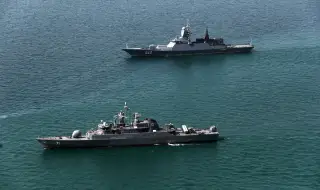
Donald Trump announced that he had ordered the Pentagon to postpone all strikes on the country's energy infrastructure for five days. He had previously issued an ultimatum that he would destroy Iran's power plants if Tehran did not open the Strait of Hormuz.
The Strait of Hormuz is practically blocked
The strait is a key artery connecting the Persian Gulf to the world's oceans. About a fifth of the world's traded oil and liquefied gas passes through it. Since the beginning of the war, Tehran has repeatedly threatened to attack ships there.
Ship traffic in the Persian Gulf and the Gulf of Oman has been virtually frozen in recent days after several vessels were attacked with missiles. The “New York Times“ reported that the US president was informed that Iran could inflict major damage with relatively simple and cheap means - just one soldier on a speedboat is enough to disable a tanker with a missile or mine. This was explained to Trump by General Dan Kaine, chairman of the US Joint Chiefs of Staff.
What are the largest power plants in Iran?
Trump had threatened that attacks could begin against the “largest” power plant in Iran, without specifying what exactly he meant. According to the International Energy Agency, by 2023, about 80 percent of Iran's electricity will be generated by natural gas-fired power plants.
The most important gas-fired power plant in Damavand is located near the capital Tehran and has a capacity of over 2,800 megawatts. Another power plant is located in Mazandaran province, located on the coast of the Caspian Sea, and has a capacity of over 2,200 megawatts.
Iran's only nuclear power plant, Bushehr, is located on the Persian Gulf coast - about 760 kilometers south of Tehran. According to IAEA chief Rafael Grossi, in mid-March a building located 350 meters from the reactor was already hit and destroyed. Given the unpredictable consequences, however, a targeted attack on the reactor seems almost impossible.
Impacts on the economy and people of Iran
A strike on Iran's gas plants could create a serious problem with the electricity supply of the population, which in turn would make it difficult to supply water, bank payments and industry.
Iran's economy has already been severely affected by the war. Even during the Persian New Year, bazaars and shopping malls remained empty. This is due not only to the attacks and long-standing sanctions, but also to the internet blockade imposed by the leadership in Tehran. For more than three weeks, the country has been largely cut off from international internet access.
Iran will completely close the Strait of Hormuz if Trump carries out his threats, a spokesman for the Revolutionary Guards had warned. Tehran has also threatened to attack seawater desalination plants in the region. Such plants have already been hit in Bahrain and Kuwait. Any new attacks on such facilities would lead to a new escalation of the conflict, which could threaten the water supply of millions.
There is hardly any other region in the world that relies so heavily on desalination plants as the Gulf states. The arid desert region of the Arabian Peninsula has almost no fresh water resources. The countries there have about 3,400 such plants, and in countries such as Qatar and Bahrain they provide over 90 percent of the drinking water supply. Many of these desalination plants are located in the Persian Gulf - just a few hundred kilometers from Iran.
A blow to the region's image
Whether the water supply throughout the Persian Gulf could be threatened depends on the number and strength of possible attacks, the Center for Strategic and International Studies (CSIS) wrote in its analysis. The interruption of water supply as a result of damage to one installation could initially be compensated by other similar facilities. More dangerous would be missile and drone attacks on larger distribution centers in the water supply network. “The psychological effect may be the strongest“, CSIS wrote.
Because such attacks would damage the image of security and stability that the Persian Gulf states are building as part of their economic model. Even if households are only forced to temporarily switch to another source of drinking water, this will already repel tourists, traders and investors from the region.
ARD (editor Alexander Detev