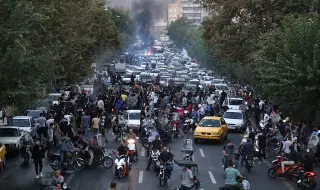
"Now we are really afraid that the government will become more radical and the atmosphere will become even more suffocating", DW sources in Iran tell us. How do people live there today?
The Israeli and US strikes against Iran may have stopped for the time being, but many people in the Islamic Republic are still afraid. The conditional two-week truce, which was reached this week, is expected to be further clarified in the coming days at a direct meeting in Pakistan. Shortly after it was announced, however, the Islamic Republic immediately began to present it as a political victory, because it managed to withstand military pressure and forced its enemies to retreat.
People in Iran do not see this as a reason to rejoice. For them, the ceasefire is a relief, but it does not mean peace. The war may have temporarily ended, but the Iranian regime remains in place and Iranians fear that after the heavy blows it has been dealt, it may now tighten repression even more.
Relief, but not security
DW spoke to an Iranian who asked to remain anonymous for security reasons. According to him, the ceasefire has not calmed the people in the country. "There is a ceasefire, but the regime has not been changed. Now we are really afraid that the government will become more radical and the atmosphere will become even more suffocating," he says. Another source from Iran told DW that many of his compatriots believed that the war could lead to regime change if the top commanders of the Revolutionary Guard were killed. However, these expectations were not fulfilled. "We thought that the regime could be ended. Now the war has ended, but nothing has changed," the Iranian said.
State media and government officials in Iran are trying to present the ceasefire as a triumph, but for many Iranians this does not correspond to reality. The regime survived, but the consequences of the war cannot be hidden. Some of the highest-ranking representatives of the Islamic Republic were killed, including Supreme Leader Ayatollah Ali Khamenei. Vital infrastructure was destroyed. This is shaping the mood in Iran, where exhaustion, uncertainty and fear reign.
Being against the war does not mean supporting the regime
The reality for the people of Iran is much more complicated than either side of the propaganda war wants to admit. Many blame the Islamic Republic for the situation the country is in. At the same time, however, they blame US President Donald Trump and Israeli Prime Minister Benjamin Netanyahu for starting a war that has made their situation even more difficult.
The people in Iran who spoke to DW say they are against the war, but that does not mean they are on the side of the regime. They do not want more bombing, destruction and suffering, but they are still opponents of the regime.
According to Babak Dorbeiki, a former representative of the Iranian Center for Strategic Studies, part of the Revolutionary Guard, there may be no interest in stopping the war at all. "The Guard is not against war. On the contrary, they now want this war", he explains. In his opinion, it is possible, and even necessary, to condemn both the war and the executions, arrests and the authoritarian regime. Any position against the war must demand that Iran change its government. This argument is also connected to another fear of the Iranians of a long war - that it will help the regime blur the boundaries between the state of Iran and the political system of the Islamic Republic, which will further complicate the opposition.
Fear of Trump and economic collapse
In the last days before the conclusion of the truce, the threats that the American president was making - to destroy bridges, power plants and "the entire civilization", were perceived by the Iranians as a direct threat to civilians. A DW source in Iran says that after these reports, the prices of generators have jumped sharply, and people have started to buy them in a panic. What worried Iranians the most was the fact that civilian infrastructure had become a bargaining chip in a war over which they had no control. The feeling of helplessness was also amplified by the ongoing internet blackout.
The war has deepened an already severe economic crisis. One source in Iran told DW that his family had used up all their savings and gold to survive. Another said that the economic pressure was so severe that some families had moved in with relatives, but now even that was not possible because everyone was in an extremely difficult situation. The war had reduced their income and prices had risen. So the ceasefire was not a triumph for these people, but just a brief relief.
Although the ceasefire temporarily halted the bombing, the major crisis in Iran has not been resolved. It remains unclear how the United States, Israel, and Iran will resolve key issues for all parties, such as sanctions, reconstruction of destroyed infrastructure, and political repression in the country.