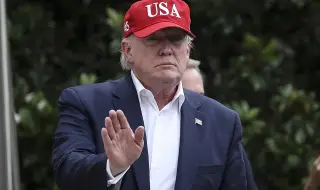
On Sunday evening, while returning from his weekend in Florida, the American president first published on his social network "Truth Social" a long attack on Pope Leo XIV. Forty-six minutes later, an image created with artificial intelligence (AI) followed. In it, Trump was dressed in a white and red robe, and with one hand he was touching the forehead of a sick person. A nurse and a soldier stood around him, and instead of angels in the sky there were fighters, eagles and fighter jets, says "Spiegel".
This is not the first time that Trump has created a new image of himself with the help of AI: in the past he has already portrayed himself as a king, a Jedi knight, Superman and even the Pope. But Trump as Jesus … this was too much even for Trump's loyal followers, the magazine notes.
"People don't make fun of God", warned Riley Gaines, a superstar of the far right. "Remove the post", demanded the influential evangelical journalist and Trump mouthpiece David Brody. On Monday morning, the image had disappeared from the official account...
Trump really likes to surround himself with clergy, but he is not particularly familiar with the Bible. The religious image, however, has probably not escaped even those who go to church only for convenience. On Monday afternoon, Trump did not answer the question "why". However, he explained what he wanted to portray: "He had to show me as a healer," the American president told reporters at the White House. Ultimately, it is true: "I care about making people feel better." The media misinterpreted the image.
Chronicle of a conflict: The Catholic Church against Trump
The portrayal of Jesus and the harsh words towards Pope Leo XIV are the temporary peak of a conflict that has been simmering for months between the American president, on the one hand, and the Catholic Church, on the other, notes "Spiegel".
Even before his election as pope in May 2025, Cardinal Robert Prevost, as the Holy Father is known by his secular name, spoke out publicly in "Ex" against the statements of the American vice president regarding the religious justification of radical migration policy. "J.D. Vance is wrong: Jesus does not require us to share our love for others" – as a counterpoint to Vance’s view that Christians should love their family first before caring for the rest of the world.
When U.S. authorities and ICE officials stepped up their crackdown on undocumented immigrants in the fall, the U.S.-born pope called on U.S. bishops to stand firmly with immigrants. He later encouraged Catholics and others to read a statement by U.S. bishops rejecting the Trump administration’s deportation campaign.
In January, Pope Leo XIV expressed concern over the arrest of Venezuelan leader Nicolás Maduro by the United States. The three most senior Catholic archbishops in the United States – Cardinal Blaise Cupich of Chicago, Cardinal Robert McElroy of Washington and Cardinal Joseph Tobin of Newark – criticized the Trump administration’s foreign policy guidelines in a strongly worded statement.
"The Moral Role" America's role in the fight against evil in the world is being questioned for the first time in decades. Citing recent events in Venezuela, Ukraine and Greenland, they called for a "truly moral foreign policy" in which military force is used only as a last resort in extreme situations, rather than as a routine instrument of national policy, the magazine recalls.
In recent days, criticism of the head of the Catholic Church has become more direct. Pope Leo has criticized, sometimes directly, sometimes implicitly, the war in Iran and the Pentagon's militarization of biblical passages. While peace negotiations were underway in Pakistan, the head of the Catholic Church sharply condemned the pursuit of power associated with violence: "Enough with the self-deification and the deification of money! Enough with the display of power! Enough with war!" The American president responded with a blasphemous attack and an image created with artificial intelligence.
As expected, Trump's inner circle refrained from criticizing their boss on Monday, Der Spiegel notes. However, according to reports, the religious freedom commission appointed by Trump himself was in session at the very moment the controversial image was deleted. Whether it was the religious leaders who intervened or perhaps Trump's associates: either way, the relatively quick withdrawal of the photo is a remarkable step.
Iranian President Massoud Pezeshkian said that "on behalf of the great nation of Iran, we condemn the insults directed at Pope Leo XIII," ANSA and Italy's Radio Uno reported.
In a post in "Ex" Pezeshkian also said that "the defamation of Jesus, the prophet of peace and brotherhood, is not acceptable to any freedom-loving person".
These comments came after Trump, in a lengthy post on "Truth Social" over the weekend and then at a briefing in Washington, sharply criticized Pope Leo XIII and implied that if it weren't for him, the "American Pope" would not have led the Roman Catholic Church. After these rebukes, the pope said he did not want to enter into a controversy with Trump, and Italian politicians, including Prime Minister Giorgia Meloni, sharply criticized the US president's comments about Leo XIV.
First American Pope Criticizes US President
Last year in May, Pope Leo XIV became the first American head of the Catholic Church, but in the first 10 months of his inauguration, he largely avoided making comments about his homeland and never once publicly named US President Donald Trump, Reuters pointed out.
But now that has come to an end.
In recent weeks, the pope has begun to emerge as a sharp critic of the war in Iran. Earlier this month, the Pope first mentioned Trump by name, directly addressing the president with an appeal to end the growing conflict.
This is a drastic change in tone and approach, which, according to experts, suggests that on the international stage the Pope will want to be a counterweight to Trump and his foreign policy goals, Reuters notes.
Catholics are an important group of voters
A direct confrontation with Pope Leo XIV carries enormous risks for Trump and Republicans, points out "Spiegel". It is true that the attack is likely to resonate with some of the right-wing supporters of Trump's slogan "Make America Great Again" with their anti-Catholic sentiments. At the same time, Catholics in the United States are a desirable electorate – and are indispensable for Republicans in the important midterm elections that are coming up in November. About 20 percent of the country's adults belong to the Catholic Church, and in some key swing states they make up as much as a third of the population. In the 2024 presidential election, about 55 percent of Catholics voted for Trump - but since then, criticism has grown not only among church dignitaries.
For now, Trump may have prevented a new escalation of the conflict by withdrawing his image. But the president immediately added that he saw no reason to apologize - and Pope Leo XIV made it clear on Monday: "I am not afraid of the Trump government." This would not be the first conflict in which the American president has misjudged his position, "Spiegel" notes.