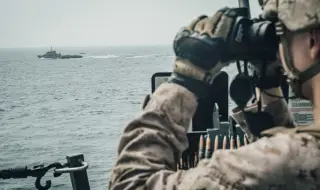
The US Navy has begun its announced blockade of the Strait of Hormuz. This affects all ships arriving from or entering Iranian ports or coastal areas, the US military's regional command announced. According to Washington, the military operation involves more than 15 warships, an aircraft carrier strike group and missile launchers.
How the blockade of the strait will work
US officials said that the goal is to deprive Iran of the advantage that control over the Strait of Hormuz gives it. Trump also said that this will stop Tehran from charging passing ships - up to $ 2 million per tanker. In a post on his Truth Social network, Donald Trump also said that the US Navy will begin to clear mines in the strait. The US military said that the blockade would not affect ships of US allies - such as Saudi Arabia, Qatar and the UAE.
The blockade will be carried out from the Arabian Sea, east of the strait itself and the Gulf of Oman and will include "the entire coast of Iran, not just ports and oil facilities”. Any ship that passes through the blocked area without authorization can be seized and diverted.
Maritime law experts say that the blockade will rely on standard navigation procedures - the so-called right of search, defined by international maritime law. According to him, US warships can stop and inspect tankers and divert them if they are suspected of carrying Iranian oil. Some experts, however, warn that while there is precedent for using this right, the blockade also enters a gray area in terms of searching neutral ships and creating obstacles to the functioning of a key international shipping route.
A few hours after the announced start of the US blockade, data showed that traffic through the strait had virtually stopped. At least two tankers were turned away when they tried to pass. Trump warned Iran not to retaliate and threatened that Tehran's few remaining warships would be "eliminated" if they came close.
How quickly could the blockade affect Iranian oil exports
The US blockade could seriously prevent Iran from exporting crude oil from its main terminal - Kharg Island in the Persian Gulf. More than 90% of Tehran's oil passes through there. The Islamic Republic has continued to export despite sanctions, using a shadowy fleet of old ships, transferring cargo to Malaysia and other tactics to circumvent the export ban.
The United States has allowed Iran to temporarily sell its oil as a measure to calm markets during the war. But the new blockade will make that much riskier and less likely. Last year, Iran's oil exports were worth about $45 billion - about 13% of the Islamic Republic's GDP, London-based Capital Economics estimates. Iran has no land pipelines through which to export its oil and has little choice but to export by sea. Even its terminal in the Gulf of Oman, Yask, could be searched by US naval forces. If the US pressure continues, it could force Tehran to quickly return to the negotiating table.
Could the blockade lead to a wider conflict
Iran's Revolutionary Guard immediately reacted to the blockade announced by Trump, saying that if Iranian ports were restricted, "no port in the Gulf and the Sea of Oman would be safe”. This has raised concerns about attacks on energy and other critical infrastructure in the Gulf states. Ebrahim Rezaei, spokesman for the National Security Committee of the Iranian parliament, said that Tehran was prepared to respond militarily if necessary. "This will complicate the situation that Trump is in and which is making the market more turbulent. We may also reveal some of our cards that we have not played so far,” he wrote in X.
Some American experts have questioned Trump's decision to block the strait - according to them, the American president risks dragging the country into a military conflict with no end in sight.
"Trump wants a quick fix. The reality is that this mission is difficult to accomplish on its own and is likely not sustainable in the medium or long term," said Dana Strull, a former senior Pentagon expert. Neil Shearing, chief economist at "Capital Economics", wrote that the blockade "may be aimed at pressuring Beijing to play a more active role as a mediator for the truce and help open the strait". China is among the hardest hit by the US blockade, as it buys 80-90% of its oil from Iran.
Author: Nick Martin