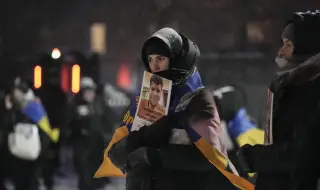
Larisa Shevandina has not seen her husband Oleh for 11 years. In May 2015, he was kidnapped from his hometown of Debaltseve in eastern Ukraine. By then, the city was already part of the self-proclaimed "Donetsk People's Republic". Since then, the two have spoken only twice - within the first 24 hours of his arrest.
According to witnesses, Oleh was stopped by masked gunmen, dragged from his car, a sack was placed over his head and taken to an unknown location. Shevandina conducted her own investigation, and later founded the organization "Ukrainian Movement - Return of Freedom".
Her husband's case was also addressed by the UN, but according to her, they do not have the means to intervene directly. "11 years in Russian captivity is a lot. If we say that every day is hell, then we have to multiply that by 365 and then by another eleven".
Violation of international law
Oleh Shevandina's detention was one of the first to become known in the Russian-occupied territories of Ukraine. From a legal point of view, his situation is defined as "in solitary confinement" - completely isolated, without the possibility of communication, without lawyers and without officially filed charges.
This is the fate of most civilians held captive by Russia - and there are many: since the beginning of the Russian invasion of Ukraine, thousands of civilians have disappeared there. Human rights activists estimate that at least 16,000 Ukrainians who did not take part in the fighting have been taken prisoner by Russia. Arbitrary arrests violate international humanitarian law. “The Geneva Convention logically does not allow any country that invades the territory of another to arrest and detain a civilian without any grounds”, commented Yuriy Kovbasa, representative of the Commissioner for Human Rights in the Ukrainian parliament.
The Russian regime justifies the detentions with “resistance to the special military operation”, as Russia calls the war against Ukraine, explains Mikhail Sava of the Ukrainian “Civil Rights Center”: “These are people who have no legal status, since their detention violates not only international law, but also Russian law.” Yuriy Kovbasa from the Ukrainian parliament adds that there is another category of prisoners. Russia has legalized their detention by providing the relevant information to the International Committee of the Red Cross. “These are citizens who may have already been convicted of “terrorism” or on the basis of fabricated convictions,” says Kovbasa.
Kidnappings and Espionage
The second category includes journalist and activist Serhiy Tsikhipa. When Russian troops occupied Nova Kakhovka in early 2022, Tsikhipa stayed behind to organize humanitarian aid and report on the situation on social media. On March 12, 2022, he was abducted. According to the human rights organization “Memorial”, Tsikhipa was held in custody for months without any formal charges. Criminal proceedings for espionage were only initiated on December 26 of that year. “Memorial” considers Tsikhipa a political prisoner.
His wife Olena has difficulty keeping in touch with him - she last received a letter from him in February, although she writes to him every week. ”The fact that he does not answer me may mean that he does not receive my letters”, she says. However, it may also mean that he is in poor health. ”They are kept in cold and damp conditions. Not only Serhiy is in poor health, but all other Ukrainian prisoners of war - both military and civilian”, says Olena. In addition, according to human rights activists and the UN, Ukrainian prisoners of war and civilians held both in Russia and in the occupied territories are subjected to systematic torture and cruel treatment by the Russian authorities.
What kind of people are being captured
Mikhail Sava from the Ukrainian ”Civil Rights Center” says that most of those arrested were socially active - they participated in volunteer actions, transported people during evacuations or simply openly declared their pro-Ukrainian positions. "In the eyes of the occupiers, they are a threat because they can become a center of organized resistance", explains Sava, and says that mass arrests also serve as a technique to intimidate the population. "They demonstrate to everyone that the same thing can happen to them - to disappear without a trace".
Retired officer Serhiy Likhomanov disappears after armed men break into his apartment in Sevastopol, on the Russian-occupied Crimean peninsula. His family later learns that he is in prison and accused of planning a terrorist attack. His sister Tatyana Selena says that her brother was arrested only because he is a former soldier in the Ukrainian army.
Selena has quit her job to devote herself entirely to the fight to bring her brother home. If that finally happens, however, she has no plans to end her work as an activist - she does not want to stop until at least those people she has met in recent years manage to free their loved ones from Russian captivity.
Author: Dasha Tussen