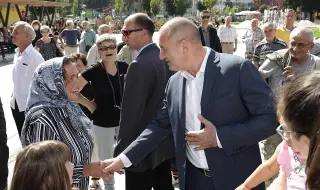
World agencies celebrated the election victory with a convincing result of the party “Progressive Bulgaria”, led by the former president Rumen Radev.
Here is how the agencies covered the elections in Bulgaria:
Great Britain: Reuters reported on the election victory of “Progressive Bulgaria” and noted that the result exceeded the predictions of sociologists. It is one of the strongest ever achieved by a single party in decades and could at least put an end to the instability that has led to eight elections in five years, the agency reported.
A Eurosceptic and former military pilot who opposes military aid to Ukraine against Moscow, Radev rode a wave of disillusionment with political instability in the Balkan country of 6.5 million people, where voters are fed up with corruption and veteran parties that have dominated politics for decades, Reuters reported, noting that Radev's campaign has drawn comparisons to Hungary's former pro-Russian Prime Minister Viktor Orban for his rhetoric about improving ties with Moscow and allowing the free flow of Russian oil and gas to Europe to resume.
Germany: Early estimates suggest that the coalition of pro-Russian former Bulgarian President Rumen Radev is on track to win a landslide victory in early parliamentary elections. elections in the country, DPA wrote.
The center-left coalition "Progressive Bulgaria" (PB), led by Radev, who resigned in January to run in the elections, received 45% of the vote, which would give the PB up to 140 deputies in the 240-seat parliament, enough for an independent majority, according to forecasts.
The German agency recalls that mass demonstrations organized by the PP-DB in December ultimately led to the fall of the previous government and pointed out that the elections in the EU and NATO member country were held after a short election campaign that was dominated by concerns about inflation and corruption, which Radev promised to eliminate.
Georgia: “It is important that the elections turned out to be successful – "the eighth in Bulgaria in the last five years, because, unfortunately, the previous period was unsuccessful in forming a majority," commented Georgian Parliament Speaker Shalva Papuashvili, quoted by the national public media GPB.
Papuashvili stressed the importance of forming a stable government in Bulgaria.
„Last November, I was in Bulgaria and met with President Rumen Radev, who had then revealed his intention to participate in elections. As you know, he resigned from the presidency in January and it seems that his party will become the leading force in these elections with the possibility of establishing a one-party majority. For us, bilateral relations with Bulgaria are a priority, given our interests in the Black Sea region, and a government with a stable majority will be formed. I believe that this will really happen“, said Papuashvili.
“As for his positions, this is a well-known trick, a movie we have seen: anyone who contradicts Brussels on any issue is immediately branded as pro-Russian. They put this label on Trump. “Georgian Dream“ was called pro-Russian. Anyone with a head on their shoulders who dares to speak critically of Brussels or contradicts it is branded as pro-Russian. "This is a propaganda technique, shouted by the intelligence services in an attempt to work against political opponents," Shalva Papuashvili said.
Spain: Pro-Russian and Eurosceptic Rumen Radev won the parliamentary elections in Bulgaria with at least 39% of the vote, a clear victory, but not enough to govern alone, the Spanish agency EFE reports.
Some analysts suggest that the former president may try to form a minority government with support from the Socialist Party, with which he shares pro-Russian positions and a more critical view of Ukraine, as well as corruption and poverty reduction.
Although Radev ran as an independent candidate in the 2016 presidential election, his candidacy was supported by the Socialists.
In addition, he maintains personal and political ties with the current party leadership – the leader of the Socialists, Krum Zarkov, was one of his closest associates, first as acting Minister of Justice in caretaker governments appointed by Radev, and later as legal advisor to the Presidency.
Kazakhstan: Rumen Radev's Progressive Bulgaria party has taken a convincing lead in Bulgaria's early parliamentary elections, securing around 45% of the vote with over 60% of ballots counted, according to data from the Central Election Commission, a correspondent for the Kazinform news agency reported.
The result puts Progressive Bulgaria significantly ahead of the liberal PP-DB coalition with 15% and former Prime Minister Boyko Borisov's GERB party with 13%, potentially equal to at least 132 seats in the 240-member parliament.
The elections, the country's eighth in five years, were sparked by mass protests against a controversial budget proposal last December.
„People rejected the complacency and arrogance of the old parties and did not fall victim to lies and manipulation. "I thank them for their trust," Radev said in his victory speech. He pledged to build a “strong Bulgaria in a strong Europe”, adding that Europe needs “critical thinking, pragmatic action and good results”.
Despite the strong results, Radev has signaled that he is open to coalition talks, as the outcome may not be enough to ensure stable one-party rule, the agency notes.
A former air force commander who stepped down from the presidency earlier this year to launch his own movement, Radev is campaigning to fight corruption and restore political stability.
On foreign policy, he has taken a cautious stance, criticizing EU sanctions against Russia and opposing military aid to Ukraine, while supporting Bulgaria's role in Europe's growing defense industry.
Poland: The “Progressive Bulgaria” coalition Rumen Radev won 44.5% of the vote in the early parliamentary elections, according to data from the Central Election Commission published today, after counting 78% of the votes cast, the Polish PAP agency reported.
Commenting on the results, Radev assured that he would “do everything possible to avoid the need to hold another early election in Bulgaria“.
The parliamentary vote yesterday was the eighth in the country since 2021 and the seventh early.
USA: The Associated Press published information about the results of the parliamentary vote in the early hours of Monday.
Sunday's elections were the eighth in the country in the last five years, embodying a crippling political impasse that has gripped this Balkan country, the agency wrote and published the immediate results.
“We will do everything possible "so that we don't have to go to elections again," Radev was quoted as saying by the AP after the first results were announced. "(New elections) would be a disaster for Bulgaria," he added.
"This would mean going from crisis to crisis, when what we need to do is work very hard to get out of these crises," Radev was also quoted as saying.
The snap elections followed the resignation of the conservative government after nationwide protests in December that brought hundreds of thousands, mostly young people, to the streets, the AP recalled. The protests called for an independent judiciary to tackle widespread corruption.
The 62-year-old former military pilot and air force chief has promised to give the country a fresh start. His supporters are divided between those who hope he will end the country's oligarchic corruption and those who support his Eurosceptic and pro-Russian views, the agency added.
Slovakia: Former President Rumen Radev's "Progressive Bulgaria" (PB) coalition won Bulgaria's snap parliamentary elections with over 44% of the vote, giving it an absolute majority in the 240-member parliament, the Slovak news agency TASR reported, citing BTA and CEC data as of 7:00 a.m. local time, when over 68% of the votes had been counted.
The PPDB came in second with 14%. GERB-SDF, led by former Prime Minister Boyko Borissov, is in a tight race with them, receiving 13.1% of the vote.
The ultranationalist party “Vazrazhdane“ and the MRF also passed the four percent threshold.
Radev announced before the elections that he wanted to win an absolute majority and rejected speculation that he would form a coalition with GERB after the elections.
These were the seventh early parliamentary elections in Bulgaria since 2021. More than 6.5 million citizens were eligible to vote in over 11,000 polling stations in the country and abroad.
Radev, who served as president for nine years, stepped down in January. During his term, he advocated pragmatic and respectful relations with Russia and criticized the sending of military aid to Ukraine. During the campaign, he promised to fight corruption. Last year, he supported anti-corruption protests that toppled the conservative-backed government.
France: Agence France-Presse reported that voter turnout exceeded 50% - the highest since 2021 - illustrating that for some Bulgarians Radev represents the possibility of unity.
“Bulgaria will make efforts to continue on its European path, but believe me, a strong Bulgaria and a strong Europe need critical thinking and pragmatism,“ he said. "Europe has become a victim of its own ambition to be a moral leader in a world governed by new rules," he was quoted as saying.
Boryana Dimitrova of Alpha Research told AFP that Rumen Radev was emerging as a "clear winner" in the election, noting that GERB's results were "far below expectations."
Rumen Radev "took away the electoral base of the pro-Kremlin Vazrazhdane party thanks to his open stance towards Russia and his anti-elitist views," political analyst Teodor Slavev told the agency.