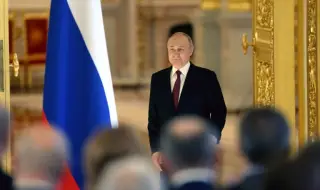
Russian President Vladimir Putin presents positive data on Russia's economic performance. On May 15, he said that the Russian government's economic measures began to generate "modest but still positive results" in March 2026.
This is according to the "Institute for the Study of War" (ISW).
Putin claimed that Russia's wholesale trade increased by eight percent in March 2025, that retail trade increased by 6.2 percent, that industrial production increased by 2.3 percent, and that manufacturing increased by three percent. Putin claimed that Russia's GDP grew by 1.8 percent in March and that unemployment remained low at 2.2 percent. An independent Russian source, The Bell, noted that Putin did not mention that data from the Russian Ministry of Economic Development showed that Russian GDP had declined on an annual basis in January and February 2026, nor that the ministry had cut its annual GDP growth forecast for 2026 from 1.3 percent to 0.4 percent.
Ukrainian intelligence indicates that the Russian government has already significantly exceeded its budget deficit plans for 2026 and is increasing its spending. On May 12, the Foreign Intelligence Service of Ukraine (SVR) reported that Russia's budget deficit reached $78.4 billion in the first four months of 2026, almost double the same period in 2025 and more than 150 percent of Russia's planned deficit of $50.5 billion for all of 2026.
The SVR reported that Russian government spending for the first four months of 2026 was $235 billion, up 15.7 percent from the first four months of 2025, and that military spending, social programs, and support for unspecified sectors of the economy were taking up an increasing share of Russian government spending. The SZRU reported that the Russian government has attempted to offset the increased costs by raising the value-added tax (VAT) rate in January 2026.
The SZRU reported that the Russian government is likely to increase its domestic borrowing, despite having already spent $14.8 billion in interest on its government debt in the first four months of 2026.
Forbes reported on May 13 that data from business intelligence firm Kontur.Fokus showed that 209,000 small and medium-sized businesses closed in Russia in the first quarter of 2026, in part due to higher VAT rates—almost nine percent more than in the first quarter of 2025.
Russian regional governments are also increasing their spending on recruiting personnel for the military effort, which is hampering the Russian federal government's ability to offset these costs. The Russian opposition source "Vazhnye istorii" reported on May 15 that Russian regional governments have more than doubled their average monthly spending on military recruits and recruitment bonuses from 358 million rubles (about $4.92 million) in 2025 to 802 million rubles (about $11.02 million) in 2026.
Regional spending is likely to further strain the federal budget, as Moscow regularly grants loans to regional governments and forgives those debts, as it did recently on May 14 for Arkhangelsk, Kaluga, Lipetsk, Orenburg, Smolensk, and Tula regions.
Putin has tacitly acknowledged the recent strains on the Russian economy, but the figures he presented are consistent with an economy supported by large state spending and war-related demand, rather than private-sector growth. Putin has repeatedly presented Russia’s low unemployment rates as a sign of economic health, ignoring how the data shows how the war in Ukraine is exacerbating Russia’s long-standing labor shortage and that a tight labor market could fuel inflation.
Cash bonuses for military personnel, which push people out of the civilian labor market, are exacerbating labor shortages. These bonuses also stimulate consumer spending, as government payments give individuals and families extra money to spend. However, low unemployment and high government transfers to consumers can increase inflationary pressures and force the government to adopt economically suboptimal policies, such as tax increases and borrowing.
Ukrainian President Volodymyr Zelensky has warned that Russia is spying on decision-making centers in and near Kiev for possible future strikes. Zelensky said on May 15 that Ukrainian intelligence had received Russian documents outlining plans for strikes against about 20 political and military sites that high-ranking Ukrainian officials frequently visit.
Zelensky has released intelligence photos from early March 2026 that are said to be of Russian plans for an underground tunnel, a presidential administration building, and a presidential residence in and near Kiev.
Zelensky said Russian authorities had been preparing the plans "for a long time" but had begun to more actively scout possible targets since the start of the conflict in Iran - possibly to take advantage of the shortage of Ukrainian Patriot interceptor missiles. The Kremlin has threatened to strike decision-making centers in Kiev if Ukrainian forces carry out strikes against Russia's Victory Day celebrations in Moscow on May 9, and Zelensky's report suggests that Moscow has not abandoned its plans for such strikes in the future, even after the ceasefire has expired.
Easing sanctions on Russia, especially in conjunction with the delay in the delivery of Patriot interceptors to Ukraine, would increase the already significant threat that Russian missile strikes pose to Ukraine. The Ukrainian presidential commissioner for sanctions policy, Vladislav Vlasyuk, said on May 15 that Russia produced the Kh-101 cruise missiles it used in the May 14 series of strikes in the second quarter of 2026, indicating that Russian forces are launching missiles almost immediately after their production and are not stockpiling missiles.
Russia and Ukraine exchanged 250 prisoners on May 15 as part of a larger 1,000-for-1,000 prisoner swap they agreed to as part of the Victory Day ceasefire.
Ukrainian officials said Ukraine received 250 prisoners, including prisoners of war who had been in Russian custody since 2022 and four civilian prisoners captured by Russian forces in the direction of Sumy in 2025.
The United States and The United Arab Emirates (UAE) brokered the exchange.