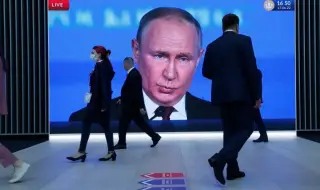
The world is currently undergoing the largest structural transformation in decades - in essence, the very paradigm of global development is changing, Russian President Vladimir Putin said today during the plenary session of the St. Petersburg International Economic Forum (SPIEF), TASS reported, quoted by BTA.
The Russian head of state drew attention to the turmoil in energy markets, the growing tension in a number of regions and the fact that against this background, European elites are making aggressive statements and provoking chaos, trying to involve as many countries as possible.
"These processes did not arise by themselves – they are a consequence of the fact that the world is experiencing the largest structural transformation in decades," Putin stressed. "And this transformation is not just a transition from one phase of the cycle to another, but a change in the very paradigm of global development," he added.
The model of global development, built over decades and presented by the West as universal and neutral, was in fact a specially created system for draining resources and forming dependencies, Putin pointed out at the forum. According to him, in practice this mechanism often functioned as an instrument for "political pressure and unfair competition".
"It has become clear that investment plans and steps for business development may face a serious risk - the risk that the external infrastructure on which they rely will be used against them," the Russian president noted. "And that is why countries are starting to develop their own technological solutions, to create their own supply routes, their own institutions", the Russian head of state believes.
True civilizations today are faced with a historic choice: to create their own technologies or to become a "digital periphery", Putin emphasized.
"Big countries, true civilizations, are faced with a historic choice: either to create their own platform and technological contours, or to become a digital periphery", he said.
Foreign digital services may seem convenient at first, but later the price of dependence on them inevitably becomes apparent. "Russia has already learned this lesson", Putin noted. "We have seen how some software providers are withdrawing from the market, how payments are being blocked, how political interference is being transferred to trade relations", he emphasized.
"We will strengthen our own vital infrastructure and cooperate only with partners who respect mutual commitments", the first person in the Kremlin pointed out.
The pressure on Russia remains, but new partners, new financial and technological solutions have appeared, Putin emphasized. Moscow considers global changes not only as a threat, but also as a huge opportunity — and therefore seeks to act quickly and pragmatically, he emphasized, explaining that the roots of the current turbulence lie in the transition from a vertical, hierarchical model working in the interests of individual countries to a more complex and multipolar world order.
According to Putin, the structure of growth is changing in favor of new centers of development in the countries of the Global South. "In these countries, the population is growing, a middle class is forming, industry is developing, the internal market is expanding. Cities, roads, ports, energy and digital networks are being built. Their own financial, educational and scientific and technological centers are emerging", the Russian president emphasized.
The race for sovereignty has not only begun, but is also gaining momentum, Putin said.
"And this is not just about the ability to resist external pressure and defend national interests. This is also a question of the quality of the state, the economy, and society", the Russian head of state noted.
The ability of a state to guarantee its sovereignty is a key factor for its position in the global economic system and for world leadership, Putin also emphasized. But the concept of "sovereignty" means "being stronger and smarter" and requires efficiency, he added.
"Sovereignty means being stronger and — I emphasize — smarter, that is, managing resources more precisely, investing more effectively, including in technological development. True sovereignty requires efficiency. We cannot say "We are sovereign, so we can work expensively, slowly and inconveniently". On the contrary — in all spheres we must act as actively as possible and with the greatest dedication," he emphasized.
Putin identified three key high-tech areas that could make a country the center of a multipolar world: its own technologies in the field of artificial intelligence (AI), autonomous systems and digital platforms. "It is obvious that technological progress is the most important factor in global transformation", the Russian president noted.
Russia has very good prospects in the field of artificial intelligence, Putin noted.
"Historically, the West was perceived by other countries as the engine of technological progress, but here too we see a serious change. Over 25 years, the BRICS countries (BRICS) have significantly increased their high-tech exports — it now exceeds a third of global supplies. This indicates a shift in technological leadership. Gradually but surely. Our strategic partner China has the most patents in the field of artificial intelligence — "an area in which Russia also has very good prospects," Putin said in his 45-minute speech.