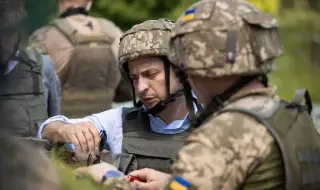
In Ukraine, the Russian president is on the defensive. But so far, there is no sign that he is ready for peace through negotiations. Is this a new turning point in the war?, asks political analyst Isabelle Lasser in an article for the French newspaper Le Figaro.
Frozen by Vladimir Putin's intransigence and stalled since their American patron committed to the war against Iran, negotiations have been brought back to the forefront, this time by Volodymyr Zelensky. In an open letter to Vladimir Putin, which he also sent to several countries, including the United States, the Ukrainian president proposed a one-on-one meeting with his Russian counterpart, as well as a complete ceasefire on the front lines. He accompanied his proposal with the following statement: "It is a historical fact that you know well: when Russia is fed up, change comes." The message is clear: act before it is too late for you. Otherwise, we will continue this "existential" war for Ukraine.
On paper, it should have been time for Putin to come to terms with the fact that peace can only be achieved through negotiations. The news has been bad for Russia since the beginning of the year. The tide has turned, and now it is crashing against the walls of the Kremlin. The audacious attack by Ukrainian drones on a naval base and oil terminal in St. Petersburg on Tuesday, as the city opened an economic forum with delegations from around the world, served as a stark reminder: the deep strikes now regularly carried out by the Ukrainian army have brought the war to Russian soil. Even Putin, who chairs this summit, intent on demonstrating Russia's strength and confidence to all its allies in the "Global South", has been forced to admit the weaknesses in its air defenses.
Expanding the scope of the war to Russia in order to open the eyes of Russian citizens is not the only goal of these deep strikes. By neutralizing 2/5 of Russia's oil and gas export capacity, they have prevented the Kremlin from taking advantage of the surge in oil prices caused by the blockade of the Strait of Hormuz. The situation on the ground is no better: the Ukrainians are gradually taking territory. With 35,000 casualties per month on the front line, Russia is now losing more men than it can recruit. So much so that the question of partial or total mobilization - an inevitably unpopular decision - is once again being discussed in Moscow. Economic indicators are also poor. Growth is slowing.
Doubt and discontent are spreading among the Russian population, which for the first time since the war began is experiencing its consequences: burning oil refineries, rising gasoline prices, internet outages. Of course, nothing could provoke an uprising in a country under strict control and surveillance, whose people have adapted remarkably well to the war of February 2022. But it is a signal that could foreshadow others. Although the influential head of the Council on Foreign and Defense Policy, Sergei Karaganov, a close ally of Putin, continues to wave the threat of nuclear war with the West if Ukraine does not surrender, some dissenting voices, both among the economic elite and among hardliners, dare to express opposing views in the media. They suggest that the goal of regime change in Kiev is unattainable and that perhaps it is time to consider peace talks.
Even Americans who supported their most powerful adversary, Vladimir Putin, seem to have lost faith in him. Condemning the "risk of escalation" after the drone attack in St. Petersburg, Secretary of State Marco Rubio now believes that Russia will not achieve its goals in Ukraine. Meanwhile, the House of Representatives has passed a bill imposing new sanctions on Russia and increased support for Ukraine. Finally, the news is bad for Putin in Europe, where the fall of his Hungarian Trojan horse, Viktor Orbán, has created a new space for the resumption of EU-Ukraine talks.
But the end of the war depends less on the changing balance of power on the ground than on the will of the man who started it: Vladimir Putin. Just as it was lacking at the start of the war, the rationality that Western powers have always attributed to Russian leaders is likely to be lacking here. Dmitry Peskov, Vladimir Putin’s spokesman, responded with a half-smile to Volodymyr Zelensky’s letter, saying that “he can come to Moscow at any time.” A Ukrainian diplomat commented: “To be arrested or poisoned…”
Although the objective facts should push the Russian president to negotiate, there is no sign that he has changed his mind. He still demands Ukraine's surrender. The possibility of expanding the war to the Baltic states is being discussed in hard-line circles of power. Can Putin survive without war, since he ultimately embodies it himself? This is one of the key questions. In Russia, the entire state, including the economy, society and politics, has been reorganized around the war. "If the balance is disturbed, there is a risk of political and economic collapse of the country. Putin has fallen into the trap of war. Whether he advances, retreats or maintains the status quo, it risks swallowing him," said a diplomat close to the situation. In 1989, Mikhail Gorbachev withdrew Soviet troops from Afghanistan after ten years of war. With the collapse of the communist economic model, the Afghan quagmire hastened the end of the USSR.
Weary of the war in Iran, Volodymyr Zelensky is seeking to turn Ukraine into a strategic player. Despite the change in hopes of improvement since the beginning of the year, Ukraine's weaknesses remain. Insufficient air defense, ammunition shortages, insufficient troops to deploy at the front and insufficient Western support. As for Russia, it still has advantages: a larger reserve of troops to deploy in case of mobilization and support from allies in the "Global South", especially China, with which ties have strengthened. The diplomat concludes: "Instead of asking Putin to resume negotiations, it would be better to provide more aid to the Ukrainians and increase pressure on Russia. This would definitively change the balance of power in the war."