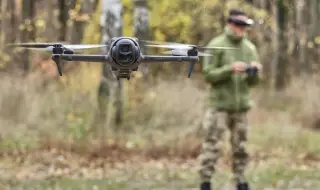
After Europe replaced the United States in financing Ukraine to repel Russian aggression, the Ministry of Defense in Kiev has managed to significantly increase the purchase of unmanned aerial vehicles, The Times writes in an article. The publication cites data from the ministry, according to which in the first quarter of this year alone, Ukraine bought 300% more medium-range attack drones than in the whole of 2025, Focus reports.
By the end of 2026, Kiev plans to produce seven million of its own drones. Over 65 percent of them are tactical strike drones.
According to The Times, the Ukrainian Armed Forces will have more FVP drones than the Russian army, and the growth of Ukraine's strike potential currently exceeds the capabilities of the Russians.
The publication quotes the Commander-in-Chief of the Armed Forces of Ukraine, Oleksandr Syrsky, according to whom the military uses twice as many strike drones per day as the Russian army. "The use of modern technology is absolutely necessary - it gives us an advantage. Currently, we outnumber the enemy in terms of the number of deployed FPV drones by a ratio of 1.7 to 1 to 2 to 1," says Syrsky. He adds that the majority of casualties among Russian troops are caused by drones.
However, the proportion of losses attributed to specific weapons systems varies depending on the weather and other conditions on the battlefield. In addition, the authors of the article note, drones have significantly influenced the course of military operations on both sides, as they have deprived them of the opportunity to conduct large-scale offensive operations.
In good weather, when drones rise into the air, any accumulations of troops within a radius of 40 kilometers from the front line are quickly detected by reconnaissance aircraft. Consequently, such accumulations are quickly destroyed. “This makes it impossible to deploy armored vehicles, since they will be destroyed long before they reach the line of battle“, admits Sirsky. Therefore, both armies can conduct offensive operations only on foot, as in World War I.