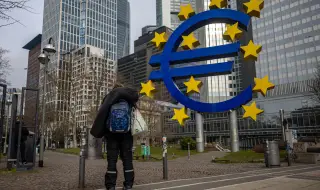
Digital currencies and cryptocurrencies were supposed to revolutionize the way we pay, but in 2026 we still need cash or a debit card to pay. Bitcoin's volatility prevents it from becoming an alternative to standard currencies.
Now, however, the European Central Bank (ECB) has a plan to create a stable digital currency. For consumers, the digital euro allows for secure transactions - in-store, online and between people, which will be backed directly by the ECB. But that's not all - the need for a digital currency is increasingly geopolitical.
Currency sovereignty in a changing world
In a world where Washington has suddenly decided to rewrite trade rules, impose tariffs and tighten control over artificial intelligence developments, the European Union believes that currency sovereignty is key to protecting against future abrupt changes brought about by the Donald Trump administration.
Europe currently relies heavily on US payment systems such as Visa and Mastercard, and digital wallets such as Google or Apple Pay create additional dependence. "If all these transactions globally start to be made in dollars without a digital euro, it would limit the effectiveness of the ECB's monetary policy towards the euro," Bas van Donselaar, managing partner at consultancy PaymentGenes, told DW.
As more trade and payments move online and are increasingly made in foreign digital currencies, the digital euro would help the ECB manage the money supply more effectively, respond to economic crises and protect the currency from external shocks.
Other major economies are moving faster, including China with its digital yuan, or e-CNY. Since it was launched in pilot mode in 2020, more than 230 million personal and about 18.8 million corporate e-CNY wallets have been created. By the end of November, China’s digital currency had processed more than 3.48 billion retail transactions worth about 16.7 trillion yuan (2.1 trillion euros), Chinese state media reported. Beijing is now taking new and bigger steps, expanding its cross-border use and even allowing interest to be earned on digital yuan savings.
Protecting European financial stability
For a digital euro, however, the main challenge is to ensure that it does not function like a bank account fully backed by cash. If that happens, European banks could lose their deposits – especially in times of crisis or bank runs – as consumers transfer their savings into digital euros.
To prevent this, the ECB has put in place safeguards. A possible €3,000 cap on digital euro holdings would automatically redirect any amount above that back to a linked bank account. The digital euro would also not bear interest, which would remove incentives to withdraw savings from banks. Companies would also be prohibited from permanently holding large amounts in these accounts.
Evelyn Whitlocks, director of the ECB’s Digital Euro Unit, described the digital euro as “a secure public alternative for digital payments, combining the ease and convenience of modern payment methods with the trust and stability of cash.”
Money and data protection concerns
Among consumers, data protection remains one of the biggest concerns. Some fear that a central bank digital currency (CBDC) could allow state control over spending, drawing comparisons to the system in China, where citizens are given a score for their behavior, including their financial reliability. Low scores can limit access to credit, jobs, public services or travel. Emmanuelle Auriol, an economics professor at the University of Economics in Toulouse, rejects any parallel:
"Social credit systems (like in China) have nothing to do with this", she told DW. "Personal data protection can be combined with measures to fight crime without creating tools for social control."
The ECB also plans to allow direct user-to-user payments between mobile phones. This would maintain anonymity similar to cash payments for small, everyday payments, while still complying with anti-money laundering rules.
How will banks be convinced
One of the biggest challenges of introducing the digital euro is the potential loss of revenue for European banks. Currently, merchants incur losses on every card payment in the form of fees - often 0.5% to 1.5% of a transaction worth €100, which are shared between the bank and the payment system operator. The digital euro aims to reduce these costs.
Many banks argue that they will be burdened with most of the costs and liability of building and operating the new infrastructure, while at the same time losing a significant source of fee revenue. They are therefore calling for fair compensation.
How the introduction will be made easier for consumers
To ensure public acceptance, the ECB is proposing that the digital euro be granted legal tender status throughout the eurozone. Under the current proposals, any merchant with a payment terminal would be required to accept digital euros at their full face value, without any additional charges for consumers.
"Like physical banknotes, the value of the digital euro would be guaranteed by the European Central Bank and national central banks - so one digital euro would always be equal to one regular euro. Unlike cryptocurrencies, its value is stable and will not fluctuate," ECB representative Evelyn Whitlocks told DW.
Countries outside the eurozone within the EU would also be able to offer the currency. The digital euro would also function offline, which could prove useful during power outages or in areas with poor internet connectivity. EU policymakers are aiming to adopt the legal framework later this year, with a pilot planned for 2027 and full implementation potentially in 2029.
Author: Nick Martin