The US armed forces early this morning again imposed a blockade on Iranian ports in response to Tehran's attacks on ships trying to pass through the Strait of Hormuz, and in response, the Islamic Republic launched new strikes against countries where US military forces are stationed, the Associated Press reported, BTA reported.
The exchange of strikes between the two countries, which has been going on for several days, as well as their attempts to establish control over the sea route through which one-fifth of the world's oil and natural gas passes in peacetime – threaten to drag the region back into full-scale war, the agency notes.
The United States first imposed the blockade in mid-April and then lifted it in mid-June, a day after signing an interim agreement that set a 60-day deadline for talks on issues such as Iran's nuclear program. But the talks have stalled and the exchange of blows in the strait has become increasingly intense.
When US President Donald Trump announced on Monday that he would resume the blockade, he also said he would impose a 20% fee on ships passing through the strait. However, he abandoned the plan to collect the fees hours before the blockade was resumed, citing requests from US allies in the Persian Gulf.
The United States launched another wave of strikes before the blockade was resumed, the US Central Command (CENTCOM) said. Early this morning, missile alerts were raised in Bahrain and Kuwait as both countries came under Iranian fire - something that has been happening almost daily lately.
Trump said in an interview with Fox News that more US strikes on Iran were coming in the next two days and that bridges and power plants could be targeted by next week unless talks resume. The US has already struck at least one bridge in Iran.
Hours after the blockade was re-established, Iranian state media reported a gunfight in the strait, without providing details.
Iran's Islamic Revolutionary Guard Corps (IRGC) said it had struck what it described as command and control facilities, logistics, fuel and military equipment belonging to the US Fifth Fleet in Bahrain. He said this was in response to US actions in the Indian Ocean and their attempts to control the Strait of Hormuz and restrict sea transport routes. The CGIR warned that if Washington tried to block oil and gas exports from the region by establishing control over sea routes, then other routes serving the interests of the US and its allies could also be closed, and said that regional energy exports would be “for all
or for none“.
Admiral Brad Cooper, who heads CENTCOM, said that Iran had launched dozens of missiles and drones against neighboring Arab countries from the Persian Gulf. "U.S. forces hold Iran accountable for its unprovoked aggression that continues to endanger the lives of innocent people," Cooper said.
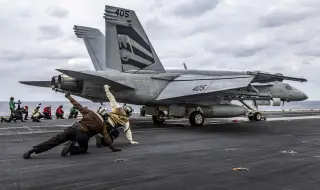
At least 19 U.S. warships are deployed in the Arabian Sea, including two aircraft carriers and an amphibious assault ship with more than 1,000 Marines aboard. CENTCOM also said in a social media post that "hundreds of warplanes are deployed throughout the Middle East."
Since the U.S. and Israel launched the war against Iran on Feb. 28, Tehran has effectively blockaded the strait, attacking and threatening ships. That has led to a surge in the prices of oil, fertilizers and other goods.
Iran recently began attacking ships passing through the strait on a route near the coast of Oman, controlled by the US military and outside Tehran's control, which triggered the latest clashes. The US has threatened to reopen the strait by force, but experts say that would require many more ships, as well as, most likely, tens of thousands of troops for a ground operation.
US President Donald Trump said in an interview with “Fox News“ last night that the strikes against Iran “will continue until I say enough“, Reuters reported, BTA writes.
In an interview broadcast on the program “Special Report“ (Special Report), Trump said that Iran's military capabilities "have been weakened" but that "they still have the strength to resist." The president said that the strikes would continue today and that he expected US forces to carry out more attacks, possibly next week.
Trump said the US was ready to destroy all of Iran's bridges and power plants if Tehran did not agree to talks.
“Next week is going to be a very bad week for them, because next week we are going to get to the power plants... the bridges. We are going to take out all of their power plants, we are going to take out all of their bridges if they do not come to the negotiating table,“ he said.
Trump also said that US officials held talks with Iran last night and urged the Islamic Republic to make a deal.