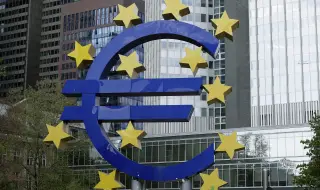
The European Central Bank (ECB) will announce its decision on key interest rates later today after a two-day meeting, with analysts and market participants estimating a 90 percent probability that interest rates will be left unchanged after the increase announced in June, BTA reported.
The ECB remains the only major Western central bank to tighten monetary policy after the conflict in the Middle East provoked a spike in energy prices and subsequent acceleration in inflation.
After the June meeting, the interest rate on the deposit facility (which banks receive when they deposit funds overnight with the ECB), the interest rate on the main refinancing operations (which banks borrow funds from the ECB for a period of one week) is at a level of 2.25 percent, the refinancing rate – to 2.40 percent, and that on the marginal lending facility (paid by banks when borrowing funds overnight from the ECB against collateral) - 2.65 percent, with all three rates being raised by a step of 25 basis points.
The decision was announced after data showed an acceleration in eurozone inflation to 3.2 percent in May, driven mainly by rising energy prices.
However, Eurostat data for June showed a slowdown in the inflation rate to 2.8 percent, with core inflation, which excludes highly volatile categories such as energy and food, at 2.4 percent, down from the 2.5 percent level reported in May and again approaching the ECB's inflation target of 2 percent.
Since June 11, when the previous meeting was held, uncertainty has increased again given the resumption of strikes by the US and Iran, heated rhetoric and the repeated blocking of the Strait of Hormuz, which is key to the access of oil, gas and other raw materials from the Middle East to the world market.
After the start of the new escalation, oil prices are rising again, although for now they remain significantly below the maximum values reached in April and May, when they jumped above $ 120 per barrel.
Although higher energy prices in the coming months could lead to an acceleration of core inflation, there are no significant secondary effects (transfer of increased raw material prices from companies to consumers, who in response may start demanding higher wages) that could fuel inflationary processes, notes the chief economist of “Barenberg“ (Berenberg) Felix Schmidt.
„There are many reasons why the ECB should wait until June. By the September meeting, the Governing Council will be able to react on the basis of new inflation and economic growth forecasts, and by then there will be two more months of inflation data – July and August“, said Ulrike Kastens, senior economist at international asset manager DWS.
Without new inflation and growth forecasts, the ECB is unlikely to take action, predicted Carsten Brzeski, global head of macroeconomic forecasting at ING.
However, the new oil price increase gives reason to expect at least one more hike in the key rate this year and some members of the Governing Council could put pressure on it to be taken sooner, with the market estimating an 85 percent probability that the ECB will raise rates by 0.25 percentage points at the first meeting after the summer break.
The ECB began a rate hike cycle in July 2022, increasing the deposit rate from -0.50 percent to 4 percent at ten consecutive hikes. Since September 2023, the Frankfurt institution has cut rates eight times, bringing the main benchmark to 2 percent before proceeding with another hike last month.
Despite the rise in prices over the past two weeks, oil futures markets are signaling a possible further decline, which would accordingly reduce the impact of energy prices on inflation, Kastens said.
Kastens expects headline inflation to return to 2 percent in the second half of next year, and it is possible that it will even be slightly below that level. Meanwhile, core inflation is likely to remain slightly higher, mainly due to inflation in the services sector, according to the D&E expert.
In her speech at the ECB Forum in Sintra a few weeks ago, ECB President Christine Lagarde stressed that the June interest rate hike was not a “precautionary hike“ but a response to a real inflation problem. She noted that the ECB's forecasts show that inflation will return to its 2 percent target only by the end of 2027, and only if monetary policy is tightened further.
Lagarde also refused to make any pre-commitments on the course of policy, saying that “future policy guidance is not in the plans” and that decisions will continue to be made on a meeting-by-meeting basis, guided by incoming economic data.
The US Federal Reserve kept its benchmark interest rate unchanged at a range of 3.50-3.75 percent in June, at its first meeting with Kevin Warsh at the helm, although his hawkish tone unsettled markets.
The Bank of England also left its key interest rate unchanged at 3.75 percent by a 7-2 vote, while the Bank of Japan raised its key interest rate to 1.0 percent - its highest level in 31 years - in an attempt to curb the yen's depreciation and rising inflationary pressures.