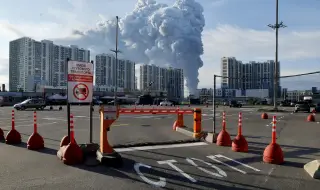
"The sky will determine the outcome of the war," Ukrainian President Volodymyr Zelensky said in early July, adding that the size of the territory now matters much less. "We have moved to the air sphere. And in the air we are competitive," Zelensky noted. A few days later, he announced a "40-day plan for long-range sanctions" carried out by the army, and on July 10, he signed a decree establishing a command for long-range actions against Russia.
"Our main goal is for our long-range influence to further push Russia towards diplomacy - by complicating weapons production, through oil and other economic losses, as well as by returning this war to the country that started it," Zelensky recently wrote on social networks.
What are the goals and how far do "long-range sanctions" reach?
The priority target of the long-range Ukrainian strikes are Russian oil refineries, oil depots and pipeline pumping stations, Ukrainian experts told DW. At the same time, the attacks targeted enterprises of the military-industrial complex, air defense facilities, missile boats and ships, logistics hubs, and recently - the warehouses of the Wildberries company, since, according to Ukrainian data, it also trades in military goods for the Russian army.
The geography of the attacks expanded far beyond the borders of Russia's "safe rear" - all the way to the Yaroslavl region, 1,300 km from the border, as well as the Perm region, more than 1,500 km away. The most distant targets reached were in the Urals and Siberia - over 3,000 km away.
Experts believe that the reason for Russia's vulnerability is precisely its geography. It is too large to physically protect its entire territory, infrastructure and logistics, the director of the New Geopolitics Research analytical center Mikhail Samus told DW.
The Ukrainian long-range campaign is based mainly on relatively cheap long-range "kamikaze" drones of its own production - they are responsible for about 54% of the targets hit and 59% of the fire missions inside Russia. One such drone costs about $55,000. In addition, missiles, such as "Flamingo", are also used for the same purpose.
What are the consequences of long-range strikes against Russia
The effect of Ukrainian strikes deep into Russian territory can already be measured, and with the help of independent sources. Leading analytics company Kpler reports that as a result of the June strikes, Russian refineries were processing only about 560,000 tons of oil per day - the lowest figure in years, and gasoline production has fallen by about 25% compared to last year. Various estimates indicate that the Ukrainian attacks have disabled about 40 percent of Russia's oil refining capacity.
The consequences of all this are also being felt by ordinary citizens - restrictions on fuel sales have been introduced in Russia, there are queues at gas stations. The Kremlin is limiting fuel exports, while increasing imports - according to reports, Moscow plans to buy up to 400,000 tons of gasoline per month.
"Currently, the focus is on strikes on oil refineries. And this is right, because it affects the supply of fuel to the Russian armed forces," Ukrainian military expert Nikolai Sungurovsky told DW. But despite the overall effectiveness of the campaign, he sees one definite drawback - that so far there is no good coordination of the strikes. "They must be coordinated in depth and at the same time be linked to strikes on the logistics of the Russian armed forces, as well as the work of diplomatic and intelligence services to stop the supply of Western components to Russia."
Will Ukraine's "long-range sanctions" lead to a sooner peace?
Ukraine's long-range strikes also have a geopolitical dimension. According to Samus, it is precisely the ability to strike inside Russia that has changed Ukraine's position in relations with the United States. "We make decisions sovereignly, without asking for help from a position of weakness. The US has effectively become a mediator, and Ukraine has its own sovereign position, because it can practically demonstrate force," Samus points out.
As for the prospects for freezing the war, both experts are rather restrained. Sungurovsky believes that deep strikes in themselves will not change the course of the war, since they are only one element of the entire complex of measures. In his opinion, events on the front continue to be of decisive importance.
Samus is even more categorical: Ukraine is unlikely to come close to peace, as Putin wants to continue the war. But at the same time, he notes that the situation is changing not in favor of Russia and will continue to change further. "There is already a real effect, and in the future it will intensify. The situation is changing strategically, and negatively for Russia,", emphasizes Samus.
Author: Liliya Rzheutskaya