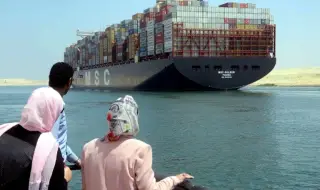
The drone strike, which a day earlier damaged two liquefied natural gas tankers in Egyptian waters, has also raised concerns about the security of energy supplies through the nearby Suez Canal and the Suez-Mediterranean pipeline (SUMED), a vital route for Saudi oil exports since the start of the war with Iran, Reuters reports.
While Iran and its Houthi allies have attacked tankers passing through the Strait of Hormuz and the Bab el-Mandeb Strait, the Suez Canal has continued to provide a safe northern route for Saudi energy exports from Red Sea ports.
Iran has threatened to halt all energy exports from the region, saying no oil should be exported from the region while the United States blocks Iranian tankers.
Iran has threatened to halt all energy exports from the Suez Canal and the Suez-Mediterranean pipeline (SUMED), a key route for Saudi oil exports since the start of the war with Iran, Reuters reports.
While Iran and its Houthi allies have attacked tankers passing through the Strait of Hormuz and the Bab el-Mandeb Strait, the Suez Canal has continued to provide a safe northern route for Saudi energy exports from Red Sea ports.
Iran has threatened to halt all energy exports from the Suez Canal and the Suez-Mediterranean pipeline (SUMED) - a vital route for Saudi oil exports since the start of the war with Iran, Reuters reports.
Iran has threatened to halt all energy exports from the Suez Canal and the Suez-Mediterranean pipeline (SUMED) - a major route for Saudi oil exports since the start of the war with Iran, Reuters reports.
Iran has threatened to halt all energy exports from the Suez Canal and the Suez Canal, a major route for Saudi oil exports from Red Sea ports.
all energy exports from the Middle East, saying that no oil should be exported from the region while the United States blocks Iranian tankers.
While no country has claimed responsibility for Wednesday's drone attack on two tankers in the Egyptian port of Damietta, located on one arm of the Nile Delta near the Mediterranean Sea, nor has it publicly threatened the Suez Canal, the potential risk to this strategic sea passage has heightened market concerns.
"Passage through the Red Sea, even via the longer route through the Mediterranean, could be at risk. "This threatens up to five million barrels of oil a day that can currently bypass the Strait of Hormuz," said Saul Kavonic, head of energy research at consultancy MST Marquee.
Currently, very few tankers pass through the Strait of Hormuz, which used to carry about a fifth of the world's oil and LNG supplies.
Since the war began, Saudi Arabia has redirected most of its oil exports to the Red Sea. But threats and attacks by the Houthis since last week have forced many tankers to stop using the route.
According to market analysis firm Kpler, increasing amounts of Saudi oil and other cargo are heading north through the Red Sea to the Suez Canal.
For customers in Asia, that means longer voyages around Africa.
In July, the volume of oil transported through the SUMED pipeline, which crosses Egypt from the Red Sea to the Mediterranean port of Sidi Kerir, rose to 28.79 million barrels, up from 19.52 million barrels in April - before the Houthis threatened to block Saudi oil exports through the Bab el-Mandeb Strait on July 20.
According to ship-tracking data from the MarineTraffic platform published on Thursday, about 30 ships are nearing the Port Said, at the Mediterranean entrance to the Suez Canal, compared with about 20 earlier in the week.
"We are seeing a clear increase in the number of crude oil and condensate tankers that are loading in the Red Sea and heading north," said George Morris of energy analytics firm Vortexa, attributing the shift to threats from the Houthis.
However, crude oil is still being transported south through the Bab el-Mandeb Strait, although at about half the volume compared to the beginning of the month, Kpler data shows. About 43% of oil loadings at Yanbu are now heading south, down from 81% in June.