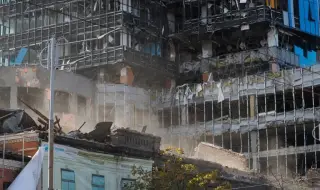
Russian drones and bombs have destroyed more than 200 gas stations in Ukraine, expanding Moscow's air campaign against civilian infrastructure and access to fuel in frontline areas, the Financial Times reports.
Ukrainian officials told the publication that the attacks have intensified in recent weeks and appear to be aimed at disrupting civilian life in areas where Russian forces are struggling. They also say the strikes are a response to Ukrainian attacks on Russian oil and gas facilities.
"Their thinking is: if we lack gasoline, why should life go on as usual for you?", said Vitaly Dyakivnych, head of the Poltava regional military administration.
Alexander Skoryk, a member of the Kharkiv regional council, said Russia had destroyed more than 200 gas stations, including at least 80 in the Kharkiv region, without specifying a period. He said the last gas station on the key route to Kiev had also been hit, although other officials disputed this.
The Russian drone squadron "Rubikon" released a video of nine daily FPV strikes on gas stations in the Kharkiv and Sumy regions. People and cars were seen nearby during some of the attacks. Ukraine has stretched hundreds of kilometers of fishing nets over roads, bridges and other infrastructure as a defense against small drones.
The Kharkiv-Kiev highway, part of the E40, is one of two main logistical corridors between the capital and the front. Skoryk urged drivers to travel with enough fuel. Ukrainians last received such warnings at the beginning of the Russian invasion in 2022.
In Poltava, four gas stations were attacked within a few hours last Saturday. Dyakivnych declined to give a total number of sites hit for security reasons, but said there was no shortage of fuel. He described the attacks as "an attempt to take revenge for the attacks on their oil refineries".
"They have failed to achieve significant success on the battlefield in recent months, their economy is performing worse and social tensions are growing," he added.
The strikes are hampering logistics and supplies and could raise the prices of goods and services. The attacks have also affected Donetsk, Dnepropetrovsk and Zaporizhia, where, according to regional governor Ivan Fedorov, more than 30 gas stations have recently been destroyed.
"Attacks on gas stations are a top priority for the enemy," he noted.
Russia uses "Geran" drones, versions of the Iranian "Shahed", other explosive drones and heavy aerial bombs. In Slavyansk, close to the front, at least two gas stations were destroyed by FPV drones in July. Facilities in the area are being reinforced with concrete blocks and nets, and some have restricted opening hours.
When there is an air raid alert, officials in Poltava warn people to “immediately leave the gas station and move away or drive away from it as far as possible.” A medic traveling to eastern Ukraine said her team waited for hours in Kharkiv for the alert to end before being able to fill up. On one road to the east, a gas station protected by nets is now only open during the day due to “increased danger and regular shelling.”
“The gas station does not operate at night. Please plan your filling in advance,” the sign reads.