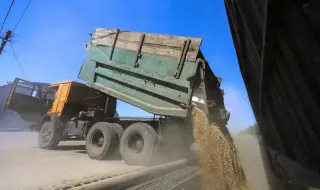
Grain exports from Ukraine via alternative routes will reach the required volume at the earliest by the end of August, Ukrainian Agriculture Minister Taras Vysotsky told Reuters on Monday. However, he warned that these corridors will be able to handle only half of the volumes processed by Ukrainian Black Sea ports, whose activities have been disrupted due to Russian attacks, BTA reported.
Russia has intensified air strikes against civilian ships flying foreign flags in the southern port center of Odessa, through which most of Ukraine's grain exports pass.
The situation threatens about half of the forecasted grain and oilseed exports this year, Vysotsky said.
„A significant part of the production – "more precisely, a little more than 30 million tons - will not be exported to international markets unless this problem is resolved," the agriculture minister said.
In July, Ukraine recorded 35 attacks on ships in ports and 22 on ships at sea, as well as 67 strikes on port infrastructure, according to the Ukrainian Ministry of Reconstruction, Infrastructure and Transport. For comparison, 14 attacks on ships were recorded in all of 2025.
As a result, shipowners have suspended sailings to ports around Odessa, where no ships have docked for almost two weeks. Against this backdrop, the summer harvest season in Ukraine is entering its peak.
Moscow claims that it is striking military targets. Russia, the world's largest wheat exporter, has also reported attacks in recent weeks on Russian agricultural export facilities and merchant ships in the Black Sea.
Ukrainian producers are already feeling the effects, as prices for oilseeds and grains have fallen by an average of 30 percent, according to Vysotsky.
“The situation is extremely complicated. In some ways, it is even more difficult than in March – "April 2022," he added, referring to the first months of the full-scale Russian invasion.
Direct losses for Ukraine's agricultural sector could reach between $1.5 billion and $3 billion this year, the minister also said.
The Ukrainian government today approved an adjustment to minimum export prices as a first emergency measure to support farmers.
Lack of long-term alternative
For Ukraine, the main alternative routes are deliveries along the Danube, heavy-duty transport and rail, with the latter being the main option, Vysotsky said.
These routes have already been used when Russia previously tried to block trade. But now the dry Danube River, which is at a historic low, will not play a significant role until October, he said.
Although authorities have started the necessary procedures and producers can now use the routes, it will take at least until the end of the summer for them to reach "a more or less stable operational level," Vysotsky stressed.
Even then, however, the alternative routes will only be able to handle between 50 and 55 percent of the monthly export capacity of Ukrainian Black Sea ports, which amounts to about 6 million tons.
The routes can serve as a temporary measure, not a long-term alternative to sea transport, Ukraine's agriculture minister explained.
The alternative routes will also lead to additional costs for producers of between $45 and $50 per ton at current prices. prices.
“There is no alternative to the ports of Odessa if Ukraine wants to continue to be a guarantor of food security“, Vysotsky said.
Food prices
In recent seasons, Ukraine has provided about 6 percent of world wheat exports and about 11 percent of world corn exports, and is also a major exporter of oilseeds and vegetable oils.
In the 2025/26 season, the country exported 34.4 million tons of grain, and according to official estimates, the surplus that could be exported this season amounts to 43 million tons.
With Russia again effectively blocking access to ports for ships, food prices could rise sharply, which will affect consumers around the world, according to Vysotsky.
“Food will become more expensive, and for the poorest people it may simply become unaffordable,“ he said.
The minister called on Ukraine's allies to help ensure security in the Black Sea, as only a strong Ukrainian military presence in the region can ensure the functioning of exports while Russian strikes continue.
He said that even if shipping traffic were to resume tomorrow, it would take at least a month for exports to return to previous levels.