Russian President Vladimir Putin has reshuffled military commanders, including those related to logistics and Russia's Unmanned Systems Forces, amid Ukrainian strikes that those structures have failed to defend against.
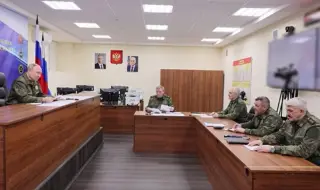
On August 5, Putin met with top Russian military commanders and Defense Ministry officials and announced a reorganization of leadership and responsibilities related to Russian military logistics, supply and procurement,
This was summarized by the Institute for the Study of War (ISW).
Putin appointed the commander of the Central Military District, Colonel General Valery Solodchuk, as deputy defense minister. Defense Logistics, replacing Colonel General Oleksandr Sanchik.
Sanchik was appointed commander of the Southern Military District (SMD) in November 2024 and since November 2025 has also held the position of Deputy Minister of Defense for Logistics.
On the night of August 4-5, Russian forces launched a relatively small strike against Ukraine, which, however, resulted in significant damage and civilian casualties, as Russia used ballistic and quasi-ballistic missiles that Ukraine failed to shoot down.
The Russian strikes resulted in a large number of civilian casualties, with at least 16 people killed and at least 29 injured in the Kyiv region alone.
Ukrainian officials reported that Russian forces had struck primarily civilian storage facilities, including warehouses of the Ukrainian chain of shopping malls "Epicenter", Ukrainian online retailer "Rozetka" and Ukrainian postal service "Nova Poshta" in and around the city of Kiev.
Ukrainian forces failed to shoot down any of the 28 missiles fired by Russia overnight, as Russia continues to deliberately exploit Ukraine's depleted stockpile of missile interceptors.
All of the missiles fired by Russian forces overnight were either ballistic missiles or missiles following ballistic trajectories that can only be intercepted by the U.S.-made Patriot systems. and their analogues.
On August 5, Ukrainian President Volodymyr Zelensky noted that since the beginning of 2026, Ukraine has received three times fewer anti-missile interceptors, mainly due to the war in the Middle East.
The addition of more North Korean missiles to the Russian arsenal will likely allow Russia to step up its ballistic missile strikes against Ukraine in the near future without having to draw from its stockpiles of "S-400" and "Tsirkon" missiles.
Russia has increasingly used "Tsirkon" missiles and modified "S-400" missiles (both follow ballistic trajectories) in their July 2026 strikes, likely to offset the strain on Russia's traditional ballistic missile production and stockpiles.
A Ukrainian defense source in the "Military" estimated on July 19 that Russia had used up up to two-thirds of its planned annual production of "Zircon" missiles in the first 19 days of July 2026 alone.