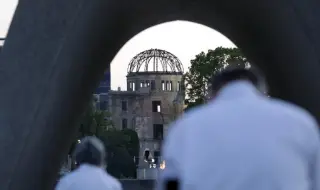
Hiroshima marked the 81st anniversary of the US atomic bombing of the city with calls for world leaders to abandon wars and the justification that nuclear weapons are a means of deterrence, the Associated Press reported, quoted by BTA.
In his speech at the memorial ceremony at the Peace Memorial Park, Mayor Kazumi Matsui warned that downplaying the inhumane nature of nuclear weapons and accepting force as an instrument of national well-being could lead to new cycles of violence similar to those that led to the bombings of Hiroshima and Nagasaki.
"Too many political leaders still consider nuclear deterrence for a realistic approach and thus legitimize violence that moves the world further away from a nuclear-free era," Matsui said.
The ceremony was attended by about 50,000 people, including representatives from approximately 120 countries and regions, including the United States and Iran. At 8:15 a.m., the minute the U.S. B-29 bomber dropped the bomb on the city, a minute of silence was observed and the peace bell rang in the Memorial Park.
Prime Minister Sanae Takaichi, who was attending the ceremony for the first time as prime minister, said she would follow a "realistic approach" towards the goal of the world never again using nuclear weapons under the Non-Proliferation Treaty.
This year's commemoration came amid growing speculation that her government, which supports nuclear deterrence, may revise Japan's three post-war principles of non-nuclear policy.
Later this year, Takaichi's government is expected to make changes to defense policy, with the possibility of dropping the principle that prohibits the import of nuclear weapons into Japan among the options under discussion. Takaichi said her country had adhered to those principles until now, but had not made a clear commitment to keeping them unchanged.
Survivors of the bombing have expressed concern about the growing international support for nuclear deterrence, including within Japan itself. It remains under the US nuclear umbrella and has repeatedly sought assurances of Washington's commitment to its security, which is why the government has rejected calls to sign the Treaty on the Prohibition of Nuclear Weapons or participate as an observer in its meetings.
The atomic bombing of Hiroshima on August 6, 1945, destroyed the city and killed an estimated 140,000 people. Three days later, a second bomb was dropped on Nagasaki, killing another 70,000. On August 15, Japan surrendered, ending World War II and half a century of Japanese aggression in Asia.
Today, the number of Hiroshima survivors has fallen to 91,105, or about a quarter of the original number, and their average age is now over 86. Many of them warn that memories are gradually fading, as the youngest survivors were too young to clearly remember the attack itself.