Taiwan's government will propose a 16% increase in defense spending next year, exceeding 1.1 trillion Taiwan dollars (about 29.5 billion euros) for the first time, Reuters reported, quoted by BTA.
The expected increase in military capabilities comes against the backdrop of increasing military and political pressure from China, whose authorities claim control over the island, the agency notes. At the same time, Taiwan has also faced calls from the United States to spend more on its own defense, which President William Lai has enthusiastically embraced.
The draft budget, to be presented on August 20, includes funding for the coast guard, veterans and special projects. The defense budget will again exceed 3% of gross domestic product, Taiwan’s Central News Agency reported.
The Taiwanese government has made military modernization a key political platform and has repeatedly pledged to spend more on its defense, including on domestically producing submarines, given the growing threat from China.
The Chinese military holds periodic military exercises near Taiwan. China is also rapidly modernizing its armed forces with new aircraft carriers, fighter jets and missiles. Beijing has refused to negotiate with Lai, calling him a "separatist."
Taiwan is currently holding its annual "Han Quan" military exercises. President Lai, who is overseeing the maneuvers today, said each exercise is an accumulation of experience that gives the military more confidence.
Today, the military practiced decontamination of weapons of mass destruction along the island's east coast, simulating a chemical weapons attack.
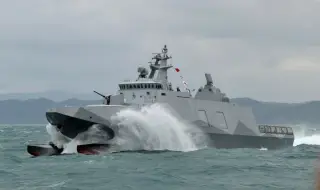
Taiwanese President William Lai observed coastal strike drills during annual military exercises yesterday, boarding a fast-moving missile boat and watching the deployment of low-flying drones to simulate repelling a Chinese attack, Reuters reported.
Taiwan launched the "Han Quan" exercises on Wednesday. The 10-day drills focus on Taiwan's preparedness against a potential invasion by China, which claims the self-ruled island as its territory and has vowed to bring it under its control, even by force if necessary. The Taiwanese government rejects Beijing's claims.
Lai boarded a naval base in the southern city of Kaohsiung, from where he broadcast a message to participating sailors.
“The purpose of the “Han Quan“ exercise is to use live troops, real terrain and live equipment to test command coordination, combat response and homeland defense capabilities,” he said. "In the face of external threats and challenges, the government will continue to work to strengthen defense capabilities, providing the military and the coast guard with the broadest support," Lai added, without directly mentioning China. "I also hope that everyone will actively respond during the exercise and strengthen coordination and mutual understanding so that they can respond to any situation and protect national sovereignty and people's safety with solid combat power," he concluded.
Lai then watched as small, low-flying attack drones circled the beach and sea. One of the coast guard's new Anping-class catamarans also participated, given that this branch of the armed forces will be used to support the fleet in wartime.